Text generation produces new natural-language content from a prompt or conversational context. In web applications, it supports content creation, marketing copy, product descriptions, conversational agents, customer support, and personalized feedback responses. section 1.1.1 section 1.1.2
A typical implementation connects a user interface, backend processing pipeline, selected model, and response interface. The backend receives input, preprocesses it, selects a model, calls internal or external services, returns generated content, and may accept feedback or follow-up questions. section 1.2.2
Generation differs from traditional predictive AI and depends on several connected ideas:
- Generative models learn patterns deeply enough to produce new content rather than only classify or recognize existing data. section 1.5
- Transformer architectures use self-attention to process sequences in parallel and capture relationships across long contexts. section 1.5
- Applications can use external APIs and models such as GPT-4 or Llama instead of hosting every generation component themselves. section 1.1.2
Marketing-copy generator
A digital marketing application can accept a product description or campaign prompt, send it through a backend to a language model, and display generated advertising copy. Users can refine the result through follow-up prompts or feedback. section 1.1.2 section 1.2.2
Figure 1.2 How an AI web app works: the user inputs data, and then the app processes it, selects a model, generates content, delivers it, and, optionally, collects feedback.
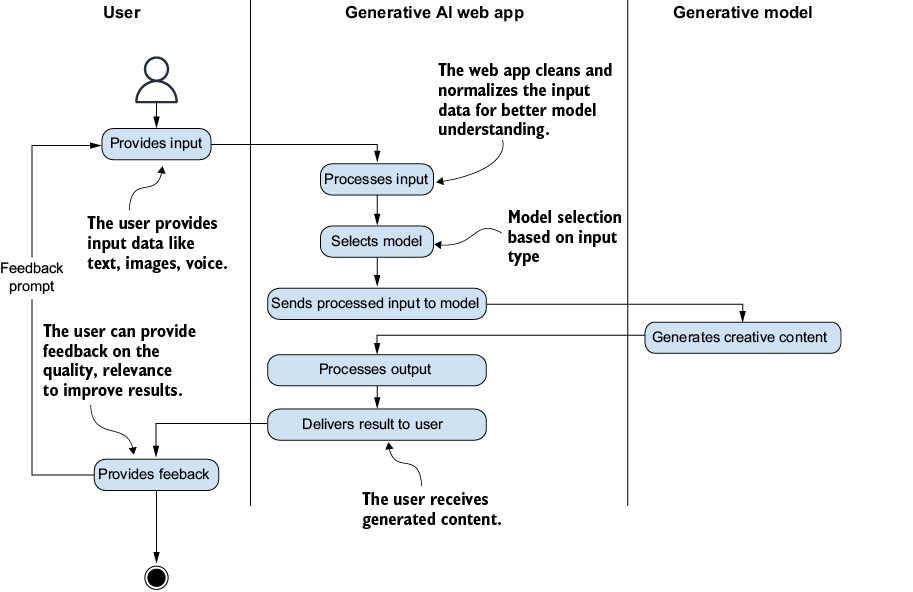
Trace the complete generation loop from user input through backend processing and model selection to content delivery and optional feedback. section 1.2.2



















