A text-to-image model generates an image matching a written description. Diffusion models begin with pure noise and repeatedly denoise it while using a text representation to guide the result. section 17.1.1 section 17.4
Figure 17.2 Language-guided image generation
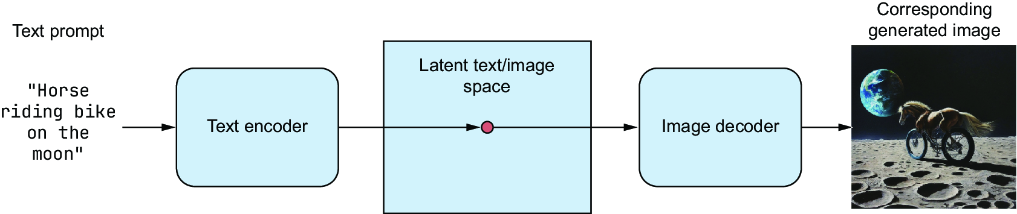
Follow the mapping from natural-language prompts into a visual latent space, then back into generated images. section 17.1.1
A typical system combines a pretrained text encoder with a diffusion model trained on prompt–image pairs. The denoiser receives both noisy images and text embeddings, allowing an unseen prompt to guide generation from pure noise. section 17.3
Generating an image with Stable Diffusion
In R with KerasHub, create a TextToImage task from the stable_diffusion_3_medium preset and generate an image from “A NASA astronaut riding an origami elephant in New York City.” Negative prompts can steer away from features such as blue color, while num_steps controls the diffusion process. section 17.3 section 17.3





