Text-to-image generation produces an image from a written description. Apps such as Midjourney and DALL-E use it for tasks such as creating a logo from a natural-language prompt. section 1.32 section 4.5
A conditional diffusion model starts with random noise and a text embedding. A U-Net-style CNN repeatedly improves the noisy image while using the caption as guidance. Training pairs corrupted images with captions and their clean originals, teaching the model to repair damage before generating new images. section 1.32
Figure 1.11 A diffusion model is trained to improve a corrupted image paired with its caption.
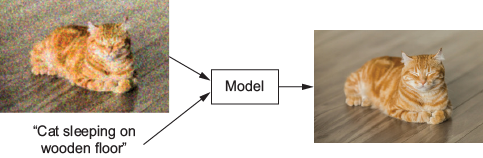
Shows the training pattern: a CNN learns to reconstruct a clean image from corruption paired with its caption. section 1.32
Figure 1.12 A diffusion model is used repeatedly to have a desired image emerge from Gaussian noise.
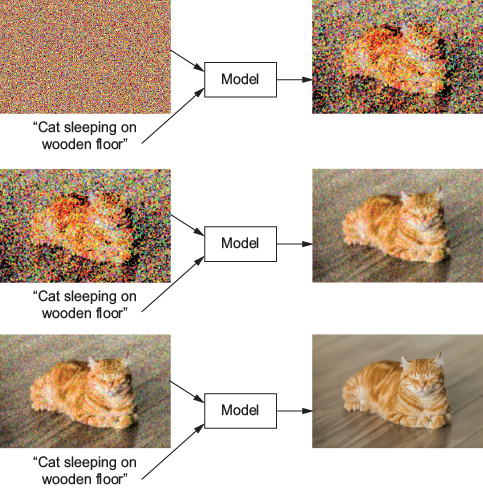
Shows generation as repeated improvement, with a desired image emerging from Gaussian noise under textual guidance. section 1.32





