Tool usage lets an LLM or agent perform functions or gather information beyond its direct response. A tool call is a task inside a larger workflow, where the result can guide the next decision. section 2.2.2
Unlike ordinary prompt instructions, tool usage connects an agent to executable capabilities and external data. The agent can choose a source, call a tool, inspect its result, and continue toward the goal. section 3.1.1 section 2.2.2
A practical tool-use loop has four parts:
- Describe the task and the decision rules clearly in the prompt. section 2.2.2
- Expose or register the required function as an available tool. section 2.5
- Let the agent call the tool to perform work or gather information. section 2.2.2
- Inspect the result and trace to verify that the call happened before the final response. section 2.5
Searching for research sources
An agent receives a research task, calls get_research_sources, and then returns its response. Registering the function with tools=[get_research_sources] and checking the trace confirms that one tool call occurred before the LLM response. section 2.5
Figure 3.1 The leading challenges developers face when building agents include fragmented tool integration, inconsistent data access, complicated multiple-agent orchestration, and security and control.
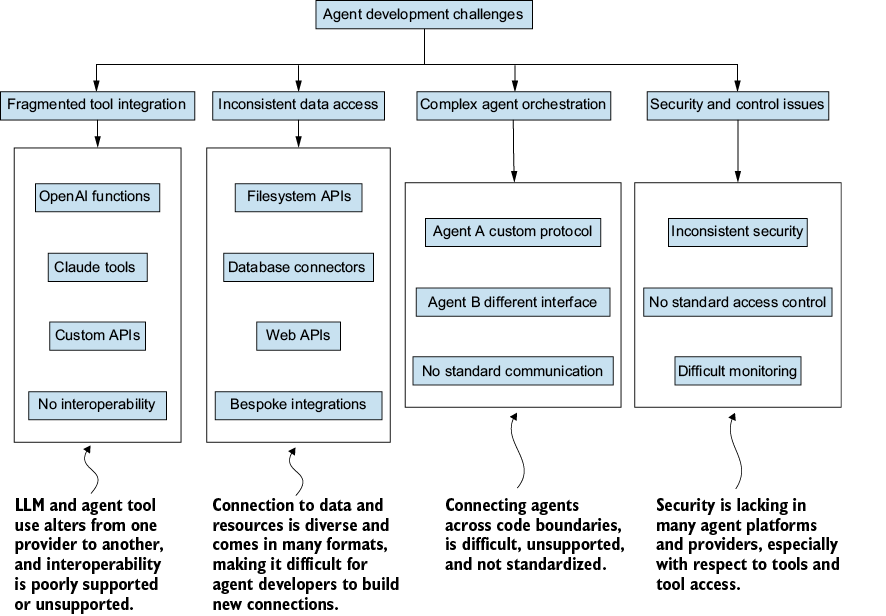
Use the figure to compare fragmented tool integration with inconsistent data access, multi-agent orchestration, and security concerns. section 3.1.1












