A U-Net is an encoder–decoder neural network with skip connections between layers at matching resolutions. In a diffusion model, it acts as the denoiser: given a noisy image and its time step, it predicts the noise added to that image. A noise scheduler uses that prediction during reverse diffusion, repeatedly refining random noise toward an image. Unlike a simple convolutional network, the U-shaped design combines broad image context with fine spatial detail. section 5.2 section 6.2.2
Trace a noisy image through the network:
- The contracting path applies convolutional layers to extract features and pooling layers to reduce spatial dimensions. As resolution falls, features represent increasingly abstract patterns. section 6.2.2
- The bottleneck processes the most condensed features before reconstruction. section 6.5
- The expansive path upsamples feature maps. Skip connections merge in features from corresponding encoder stages, helping retain details that downsampling might lose. section 6.2.2 section 6.5
Figure 6.4 The components of the denoising U-Net model
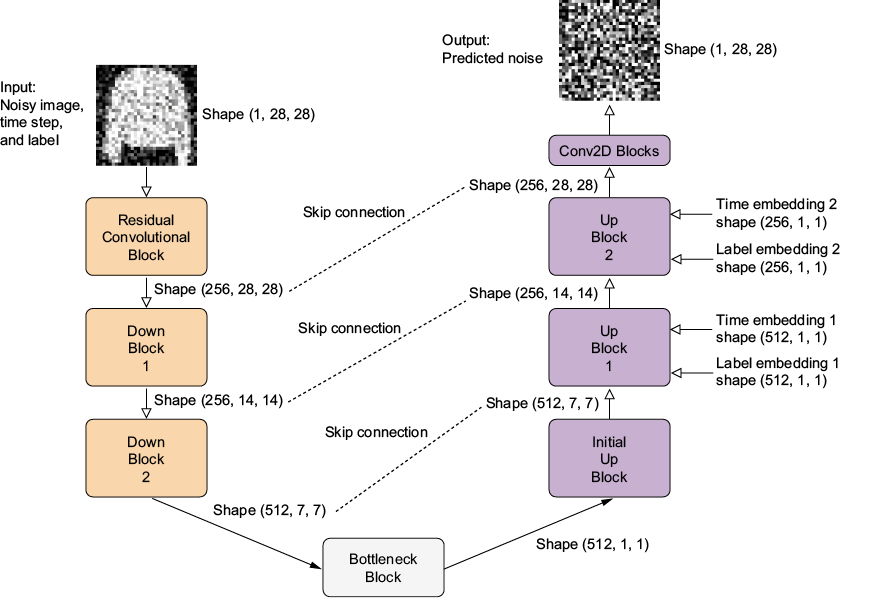
Follow the contracting path, bottleneck, and expansive path in the denoising U-Net diagram; note where encoder features rejoin the decoder. section 6.2.2
To train one, sample a time step for each clean image, add a known amount of random noise, and pass the noisy image and time step to the U-Net. Compare its predicted noise with the noise actually added, then update the weights. One clothing-image implementation uses L1 loss; a conditional DDPM implementation uses mean squared error. The target is the injected noise—not a clean image produced in a single pass. section 5.3.1 section 6.3
For controlled generation, embed class labels alongside time steps so the U-Net can denoise for a requested clothing category. For more complex images, a deeper U-Net can add attention in its downsampling and upsampling paths, dynamically emphasizing relevant spatial regions. The high-resolution flower implementation uses scaled dot-product attention over image pixels and has more than 133 million parameters: added capacity comes with substantial model size. section 6.3 section 7.1.1 section 7.3
From clothing items to flowers
A conditional U-Net can be trained on labeled Fashion MNIST images to generate a requested type of clothing item. An unconditional flower U-Net instead embeds time steps without class labels; paired with a DDIM scheduler, it turns distinct initial noise tensors into different flower images over 50 inference steps. section 6.3.3 section 7.3.1 section 7.4.1
A U-Net can also denoise compact image representations rather than pixels. In latent diffusion, it works alongside a text encoder and a variational autoencoder: text conditions iterative denoising in latent space, then the autoencoder decodes the result into an image. Training such a system is computationally expensive, so a pretrained model is used for the text-to-image example. section 9.1.2




