liveBook · Manning

Unified Modeling Language

As explained in Functional Design and Architecture: Examples in Haskell

UML is a standardized visual modeling language for specifying, visualizing, and documenting software systems.

Unified Modeling Language (UML) is a visual modeling language for organizing requirements and communicating software design ideas before coding. It is used chiefly with object-oriented design, while some diagrams remain independent of the implementation paradigm. section 1.3 section 1.6

Engine-control requirements

A use-case diagram can show an astronaut starting and stopping an engine within a control subsystem. The astronaut is an actor, while engine operations are actions situated in their operational context. The same requirements can be expressed without committing to an object-oriented, imperative, or functional implementation. section 1.3

Figure 1.5 Use case diagram for the engine control subsystem
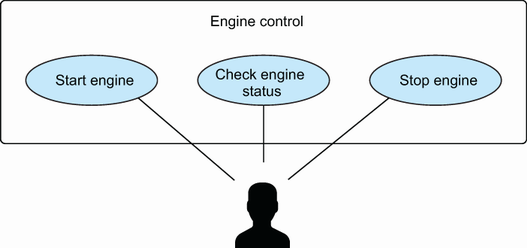
Inspect the engine-control use-case diagram to see how an actor, actions, and subsystem context organize requirements visually. section 1.3


How Functional Design and Architecture: Examples in Haskell covers it

How deep it goes
Defines use-case diagrams through actors, actions, and context, but stops short of detailing UML notation or construction.
Examples
Uses an astronaut controlling an engine subsystem through start and stop actions.
What it assumes
Builds from actors, actions, and context while avoiding dependence on a specific implementation stack.
What you can do after
Apply it via use-case diagrams to organize requirements and communicate design ideas before implementation.
How it connects
Relates requirements, use-case diagrams, object-oriented design, and functional declarative design.

Also explained in

Compare how 2 books explain Unified Modeling Language →

Related concepts

This explainer was generated by Manning's knowledge graph from the text of Functional Design and Architecture: Examples in Haskell. The section links point to the parts of the book it draws on.