You are about to raise money, and an investor asks what your startup is worth. That number is its valuation: an estimate of the company’s monetary value. For a private startup, it is subjective because the shares are illiquid rather than traded on a market. For a public company, the comparable term is market capitalization. section 20.3 section 20.2.2
In a priced financing, valuation sets the price paid for newly issued shares. Pre-money valuation is the value before the new cash arrives. Post-money valuation is the value immediately after investment: pre-money valuation plus the cash raised. Do not treat post-money as a guaranteed floor; poor product, customer, or leadership results can still lower the company’s value. section 10.4
Figure 10.1 Pre- and post-money valuations for a sample seed and Series A. Values are in millions, except price per share.
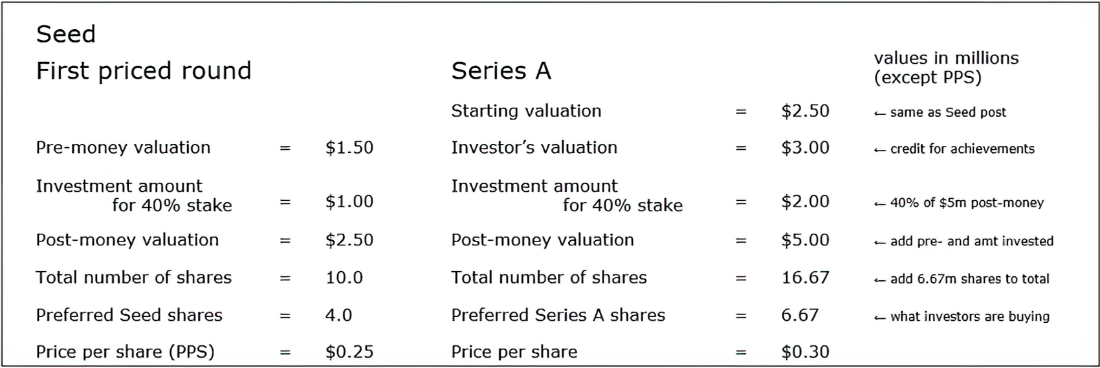
Compare a sample seed and Series A to see how a priced round connects pre-money value, new investment, post-money value, and price per share. section 10.4
A startup’s valuation may come from a 409A appraisal, from professional investors setting the price for a financing round, or from investment bankers as an exit approaches. Early on, investors may weigh the team, intellectual property, comparable companies, and product or market stage. None of these inputs makes the result fully objective. section 20.1 section 10.4
Valuation matters because it changes the tradeoff behind dilution. A financing round creates shares for new investors, reducing each existing holder’s ownership percentage. But a smaller percentage can be worth more when the new share price and overall valuation rise enough. The dangerous case is a flat or down round, where ownership dilutes without a compensating increase in share value. section 20.2 section 20.2.1
A dilution result that is not automatically bad
Imagine owning 1,000 shares out of 1,000,000. If the company issues 500,000 new shares, your percentage ownership falls. Yet if the price per share rises from $1 to $2, the company’s valuation and the value of your stake can increase despite the dilution. Ask both questions: what percentage do I own, and what is that percentage worth? section 20.2.1
Practical valuation advice:
- Keep an eye on valuation, especially near fundraising or an exit, but do not let it replace more urgent operating work. section 20.0
- Prefer a credible, steady rise over a dramatic jump that makes a future down round more likely and more demoralizing. section 20.2.2 section 20.3
- Build value through progress that investors and acquirers can recognize, rather than assuming valuation is entirely outside your control. section 20.3
- Learn how your market values companies: revenue multiples may matter, while other markets may emphasize users, churn, efficacy, clinical progress, or reimbursement. section 31.2.2
At acquisition, buyers commonly value a growing company partly as a multiple of current revenue, with the multiple varying by industry and business model. They are also judging where the company is going, not merely where it stands today. A valuation is therefore a price signal about expected future progress as well as current evidence. section 31.1 section 20.2.2

