Vibe coding prompts AI to build a feature, then ships the generated code with limited effort spent understanding it. It produces working software quickly but can create comprehension debt: code that runs while its architecture, assumptions, and connections remain unclear. section 1.0 section 1.6
Vibe coding separates two working modes:
- Coder mode asks, “Build X for me,” outsourcing problem-solving and leaving a black box that is harder to modify or debug. section 1.3.2
- Engineer mode asks, “Explain X to me,” building a mental model before generating code and strengthening architectural judgment. section 1.3.2
- Useful verification prompts include “Explain it in one sentence,” “Draw a diagram,” and “Give me an alternative approach, with its trade-offs.” section 1.6
A better AI interaction
Instead of asking AI to build a feature and accepting the result, ask it to explain the system first, expose assumptions, draw its structure, and compare alternatives before implementation. section 1.3.2
Figure 1.4 A developer stands at a fork. One path descends to "coder mode," where they say, "build X for me," outsource understanding, and find the ground crumbling. The other path climbs to "engineer mode," where they say, "explain X to me," and build a mental model with each step. The same person, using the same AI, gets two different outcomes depending on which mode they choose.
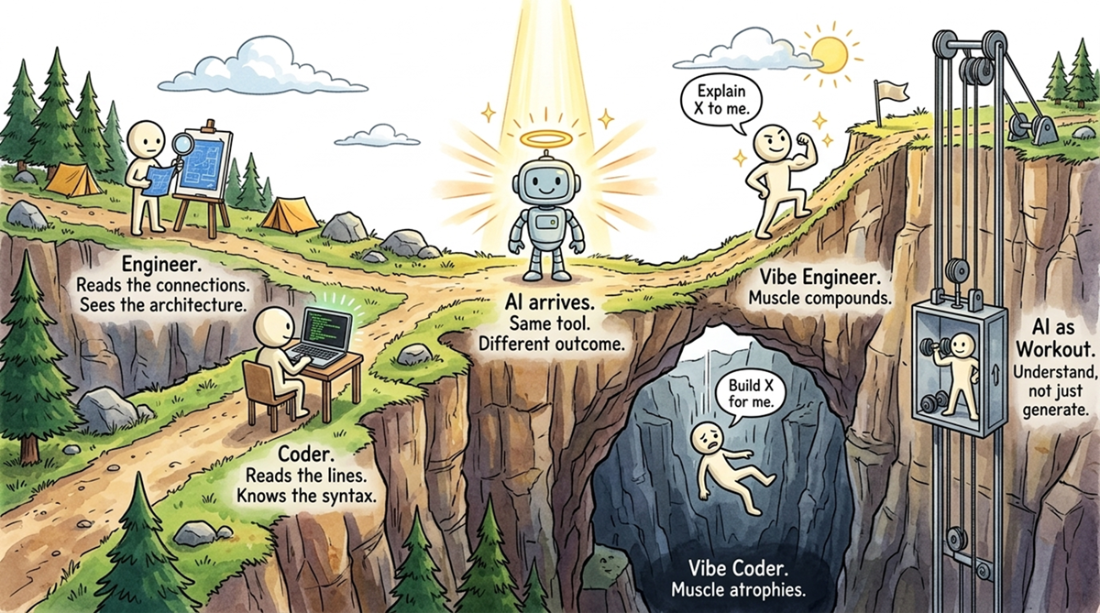
Use the fork between coder mode and engineer mode to compare identical AI tools producing either comprehension debt or a durable mental model. section 1.3.2




