AI assistance
AI assistance in software development is the use of artificial-intelligence systems to support or augment tasks such as coding, testing, analysis, and design.
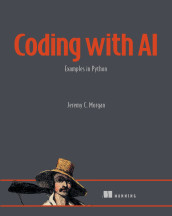
Coding with AI
A conversational programming approach in which developers guide an AI system with natural-language requests instead of detailed specifications.
- How it is used
- Uses conversational AI to turn ideas into prototypes and support development workflows, while retaining structured practices for important applications.
- How deep it goes
- Defines vibe coding and walks through an initial prompt, a game run, and a conversational revision with diff review.
- Examples
- Builds a Python river-crossing game in Cursor, then requests changes to prevent overlapping logs.
- What you can do after
- Applies vibe coding via Cursor to prototype, request revisions, inspect changes, and test results.

Vibe Engineering
A software-development approach in which AI systems assist people with activities across the development lifecycle.
- How it is used
- Uses AI assistance for exploration, implementation, planning, and verification while retaining human responsibility for production code.
- How deep it goes
- Contrasts rapid prototyping with a verification-first loop and illustrates executable specifications, focused prompts, and controls for distinct failure classes.
- Examples
- Uses a 30-day refund policy, an ISBN-13 validator, and a JavaScript XML-to-REST migration to illustrate assisted development.
- What you can do after
- Practice verification-first AI assistance by specifying behavior, assigning focused tasks, checking results, and retaining ownership.
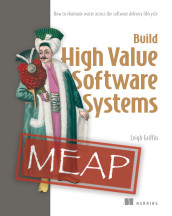
Build High Value Software Systems
AI-assisted development is software development in which artificial-intelligence systems support activities such as coding, design, testing, or documentation.
- How it is used
- Frames AI assistance as a way to reduce repetitive effort while preserving human decisions about valuable software behavior.
- How deep it goes
- Explains shifted delivery constraints and gives practical boundaries for prompting and review, without detailing AI implementation internals.
- Examples
- Uses an AI-generated endpoint with an unintended order rule and rules for intent statements, tests, and specification-linked prompts.
- What you can do after
- Practice/perform AI-assisted changes with explicit intent, review-ready code, and human ownership of final behavior.
Read how Build High Value Software Systems explains AI assistance →
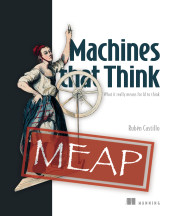
Machines that Think
A software-development technique in which a person builds software through iterative natural-language interaction with a model instead of manually implementing each step.
- How it is used
- Lowers the barrier from product idea to prototype through iterative natural-language interaction.
- How deep it goes
- Outlines the describe-review-refine workflow and ongoing development responsibilities, while leaving its suitability for production software open.
- Examples
- Uses prototypes, internal tools, and early product versions to illustrate the technique.
- What you can do after
- Apply it via Lovable, Bolt, or Replit Agent to create early software versions and review their output.
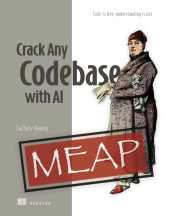
Crack Any Codebase with AI
Vibe coding is a style of software development in which an AI is prompted to build functionality while the developer gives limited attention to understanding the resulting code.
- How it is used
- Frames AI-assisted development as a choice between shipping unexplained code and deliberately building understanding first.
- How deep it goes
- Defines the practice, contrasts its modes and consequences, and stops short of implementation mechanics.
- Examples
- Uses the prompts “Build X for me” and “Explain X to me,” plus diagramming and trade-off questions.
- What you can do after
- Evaluate AI-generated code by questioning assumptions, verifying claims, and choosing understanding before implementation.
Read how Crack Any Codebase with AI explains AI assistance →
Also covered in
- Software Architecture Decision-MakingIn early access (MEAP)
- Python Workout, Second Edition
- Decision EngineeringIn early access (MEAP)
- AI Agents in Action, Second Edition
- Context EngineeringIn early access (MEAP)
- AI for Everyday IT
- PostgreSQL Mistakes and How to Avoid Them
What to know first
- conversational aiConversational AI is artificial intelligence that enables software systems to interpret user input and interact with users through natural-language dialogue.
- artificial intelligenceArtificial intelligence is the field of computing concerned with creating systems that perform tasks associated with intelligence, such as learning, reasoning, perception, and decision-making.
- AI agentAn AI agent is a computational system that uses artificial intelligence to interpret information and select or perform actions toward goals while interacting with an environment.
- JavaScriptJavaScript is a high-level, dynamically typed programming language standardized as ECMAScript and used for web and general-purpose programming.
Related concepts
- artificial intelligenceuses · Artificial intelligence is the field of computing concerned with creating systems that perform tasks associated with intelligence, such as learning, reasoning, perception, and decision-making.
- conversational aiuses · Conversational AI is artificial intelligence that enables software systems to interpret user input and interact with users through natural-language dialogue.
- language modeluses · A language model is a computational model that represents patterns in linguistic sequences to assign probabilities, predict, generate, or evaluate language.
- comprehension debtproduces · Comprehension debt is the accumulated gap between the complexity of software and its maintainers’ understanding of its architecture, assumptions, and behavior.
- Cursorused by · Cursor is an AI-powered code editor that integrates artificial-intelligence assistance into software development.
Questions about AI assistance
What is AI assistance?
AI assistance in software development is the use of artificial-intelligence systems to support or augment tasks such as coding, testing, analysis, and design.
Which Manning books explain AI assistance?
Coding with AI, Vibe Engineering, Build High Value Software Systems, Machines that Think and Crack Any Codebase with AI.
What should I know before learning AI assistance?
Manning books that teach AI assistance usually introduce conversational ai, artificial intelligence, AI agent and JavaScript first.
What is AI assistance a kind of?
AI assistance is a kind of conversational programming. A programming approach in which software is developed by interacting with an AI system through natural-language conversation.
These guides are generated from the text of Manning books by Manning's knowledge graph and link to the sections they draw on. The full books are available on liveBook and at manning.com.