A voxel is the three-dimensional equivalent of a pixel: it encloses a volume of space and usually sits in a three-dimensional grid. In CT scans, each voxel stores a numeric value that roughly represents the average mass density inside it. section 11.3
Voxels can be cubic, but CT data may use rectangular prisms with different length, width, and height. Their values help distinguish dense bone and metal from air, lung tissue, fat, and other tissue. section 11.3
Working with voxels requires consistent coordinate units. Physical locations measured in millimeters must be transformed into voxel-array addresses—index, row, and column—before extracting data. section 12.4.1
Finding anatomy in a CT array
A candidate nodule location expressed as patient coordinates (X,Y,Z) cannot be used directly as an array index. DICOM or MetaImage header metadata supplies the transformation to voxel coordinates (I,R,C), allowing the corresponding CT region to be sliced. section 12.4.1
Figure 12.5 Using the transformation information to convert a nodule center coordinate in candidate coordinates (X,Y,Z) to an array index (I,R,C)
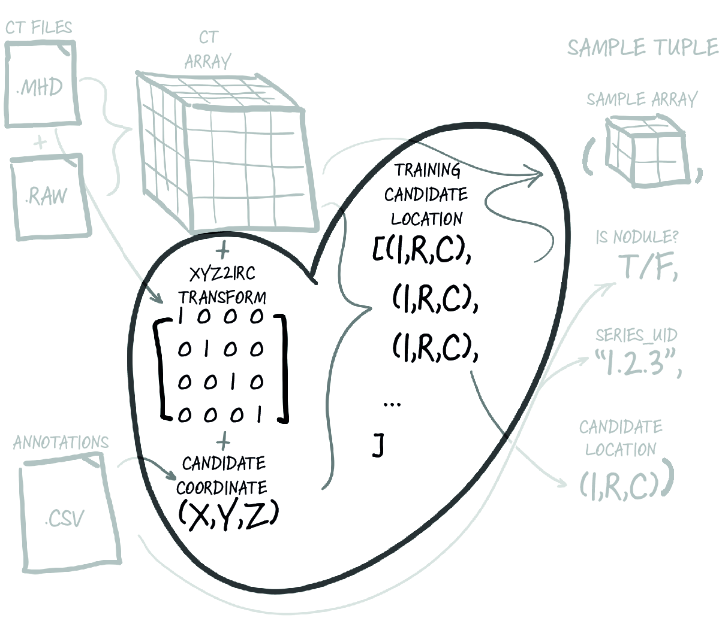
Trace how transformation information converts a nodule center from patient coordinates into a CT-array address. section 12.4.1

