A voxel is the 3D counterpart of a pixel: a small cell in a regularly sampled grid. Where a 2D image is an array of colored squares, a 3D image is an array of 2D images made of cubes. A voxel can store color, a grayscale measurement, a one-bit occupancy flag, or another value associated with that fragment of space. section 12.0 section 12.4.1
Figure 12.1 The same data (a) represented as an array of colors: a 2D 4×2 image made of pixels (b) and a 3D 2×2×2 image made of voxels (c)
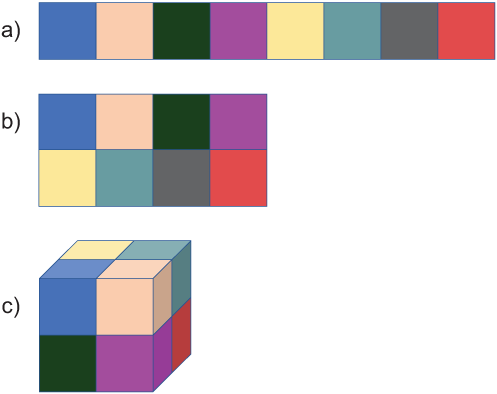
Compare the 2D pixel array with the 3D voxel array: the added grid dimension gives each cell volume. section 12.0
In computed tomography, each voxel holds an estimate of how much tissue absorbs x-ray radiation, measured in Hounsfield units. Many x-ray views are combined to reconstruct this 3D grid. Air, water, soft tissue, bone, and metal occupy very different value ranges, which makes voxel values useful for finding structures. section 12.1
A raw grayscale volume is often converted into an image mask, also called a voxel model. Each same-sized cell then records whether that location belongs to the object of interest. Threshold segmentation, for example, can classify voxels with radiodensity from 300 to 3000 HU as probable bone. This is practical but imperfect: a narrow range can omit porous or low-density bone, while a broad range can retain noise. section 12.0 section 12.2
Voxel grids make local spatial operations especially direct:
- Dilation grows a filled region by filling empty voxels near filled neighbors. For larger depths, a two-pass distance computation can identify every voxel within the chosen distance at once. section 12.3.1
- Erosion is the dual of dilation and can be implemented by inverting filled and empty cells, dilating, then inverting again. section 12.3.3
- Denoising erodes a mask and dilates it back by the same amount, removing small isolated artifacts and smoothing borders while preserving sufficiently broad features. section 12.3.3
- Boolean operations and intersection detection are fast and reliable when voxel-model operands share a grid. section 12.8
Cleaning a segmented scan
Represent filled cells as 1 and empty cells as 0. After thresholding a CT volume, a small non-bone artifact may still be marked filled. Erode the mask by the expected noise size, then dilate by that same size. The small artifact disappears, but a thick connected feature remains; a thin feature may disappear too, so the chosen size is a real modeling trade-off. section 12.2 section 12.3.3
Voxels trade precision and memory for robust grid-based processing. They store an entire 3D model rather than only its boundary, so increasing resolution can be costly. Parametric surfaces are preferred where engineering and manufacturing require precision; triangle meshes offer a simpler boundary approximation; signed distance fields, boundary representations, and voxel models can be converted between as a workflow demands. section 12.5 section 12.8