Noise consists of points in low-density regions that density-based clustering does not assign to any cluster. DBSCAN treats noise and outliers as equivalent labels, allowing clusters to follow dense, non-spherical regions instead of forcing every point into a group. section 12.3
Identify noise through local density and reachability:
- Mark a point as a core point when it has at least the required number of neighbors within radius ε. section 12.3.1
- Expand clusters through directly reachable and density-reachable points connected by paths of core points. section 12.3.1
- Mark a point as noise when no other point makes it reachable from a core region. section 12.3.1
- Leave non-core edge points in a cluster when they lie within ε of a core point; their assignment can depend on processing order. section 12.3.1 section 12.3.2
Why density-based noise handling matters
A few isolated observations can represent signal noise, a newly observed flower species, or an unusual customer behavior. Unlike k-means, DBSCAN does not force such points into the nearest cluster, where they could pull centroids away from better positions. section 12.1.1 section 12.2.1
Figure 12.9 Core points, directly reachable points, and reachable points, given a radius ϵ and a threshold minPoints (the minimum number of points in a core region) equal to 3; hence, core points need to have at least two neighbors within distance ϵ.
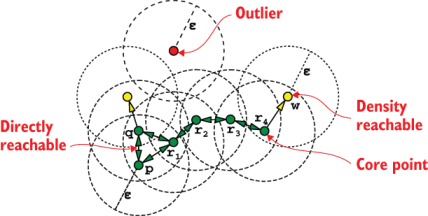
Use the diagram to distinguish core points, directly reachable points, and points that remain outside every reachable dense region. section 12.3.1










