Noise is random perturbation added to an image during diffusion. The forward process increases noise step by step until the image becomes random noise; the reverse process removes it to recover or generate a clean image. section 15.0 section 1.3.3
A diffusion workflow uses noise in two connected ways:
- Training adds increasing amounts of noise to clean images, creating examples at different diffusion steps. section 15.0
- Generation starts from random noise and progressively removes it, producing a new image resembling the training data. section 15.0 section 1.3.3
Flower-image diffusion
Take high-quality flower images and add noise at successive steps until they become pure random noise. Train the model on these noisy images so it can learn the reverse sequence and reconstruct clean flowers from noise. section 1.3.3
Figure 1.7 The diffusion model adds more and more noise to the images and learns to reconstruct them. The left column contains four original flower images. As we move to the right, some noise is added to the images in each time step, until at the right column, the four images are pure random noise. We then use these images to train a diffusion-based model to progressively remove noise from noisy images to generate new data samples.
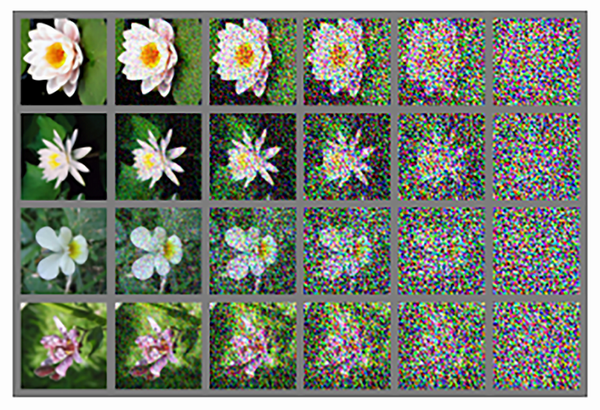
Trace the visual progression from original flower images through increasing noise to pure random noise, then follow the learned reconstruction process. section 1.3.3










