Noise is random variation added to an image, progressively obscuring its visual information. In diffusion models, controlled noise transforms a clean image into random noise and supports a learnable reverse denoising process. section 5.1.1 section 1.3.1
Diffusion uses noise in a sequence of practical stages:
- Start with a clean image at time step 0 and add small amounts of normally distributed noise through successive time steps. section 1.3.1
- Reach approximately pure random noise at the final step, typically using 1,000 training steps. section 5.1.1
- Train a denoising U-Net to predict the noise injected into each noisy image, using the actual noise as the target. section 5.3.1
- Generate images by starting from random noise and iteratively removing noise, optionally conditioning each step on text. section 10.2.1 section 7.4
Visualizing a noise schedule
Take four flower images and display them at time steps 0, 200, 400, 600, 800, and 1,000. The images become progressively noisier until the final column shows pure random noise. section 7.2.2
Figure 5.2 The forward diffusion process
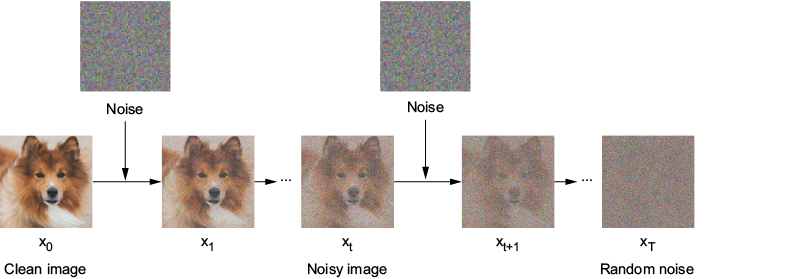
Trace the forward diffusion process from a clean dog image through increasingly noisy states to pure noise. section 5.1.1










