A worker agent is a specialist given a bounded task by another agent. Think of an orchestrator as a coordinator: it chooses what needs doing, hands a subtask to the appropriate worker, and uses the returned result to decide what happens next. A worker may use several tools or plan within its own task, but it does not own the overall goal. section 1.4.2 section 9.3
Figure 1.13 The agent orchestration pattern, often called hub-and-spoke. A central agent acts as the hub, or orchestrator, delegating tasks to worker agents. The worker agents complete their tasks and return the results to the hub, which determines when the goal is complete and outputs the results.
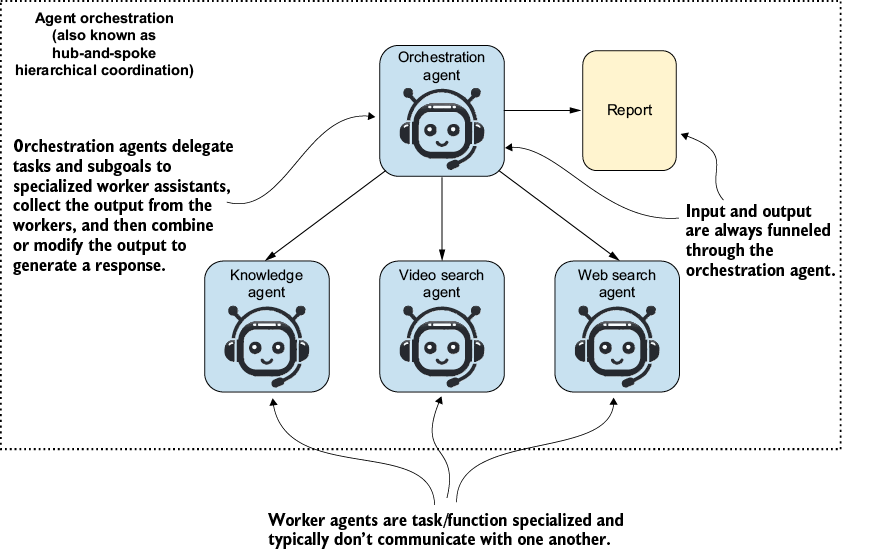
The hub-and-spoke diagram shows the boundary: workers return results to the central orchestrator, which decides when the goal is complete. section 1.4.2
The worker’s role depends on the control pattern:
- In an orchestration, one agent selects workers as needed and evaluates their results. A worker can fail without necessarily ending the whole workflow, but the orchestrator needs evaluation and guardrails. section 4.1.1 section 9.3
- In a manager–worker hierarchy, managers pass commands through levels; workers retain control over executing their assigned tasks. section 4.1.1
- In an agent flow, agents communicate without a central decision-maker. That is different from being delegated a task by an orchestrator. section 4.1.1
Research and analysis workers
For a goal with several parts, an orchestrator can delegate searching to a research worker and interpretation to an analysis worker. It keeps the global plan and state, checks whether their findings meet the goal, then delegates again, revises the plan, or finalizes. A practice goal is comparing the environmental effects and cost effectiveness of residential solar and wind energy while printing each decision and the aggregated findings. section 9.3 section 9.5
Keep worker responsibilities narrow enough to inspect. In a deep-research system, a planner can delegate search, extraction, analysis, and summarization to stateless, tool-like workers. Give factual claims a retrieval or documentation source, add a fact-checking pass, and budget tool calls. Use an agent as a tool when the delegated work requires decisions; otherwise, a direct tool may suffice. Start with a simpler system if it already solves the goal. section 11.4 section 11.5








