Active listening makes understanding visible. In collaborative modeling, it means checking—verbally and nonverbally—whether a speaker’s message, terms, and intent have been understood. Rather than rushing to a solution, listen for meaning, clean up ambiguous language, ask questions, and summarize what you heard. This helps a group replace assumed agreement with shared understanding. section 5.3.2 section 5.9
Use active listening as a facilitation skill, not as passive politeness. It supports neutrality and observing, while clear communication and holding space reinforce it. The skill can be learned and improved through deliberate practice; its effectiveness also depends on self-awareness, adaptability, culture, status, and whether people permit the facilitator to use it. section 5.2 section 5.3 section 5.9
A practical listening loop during a difficult design conversation:
- Give the speaker full attention. Do not interrupt, counter with a personal opinion, or immediately try to fix the problem. section 5.6 section 8.3.1
- Ask an open, empathetic invitation such as “Can you tell me more about what you just shared?” section 5.6
- Clarify important words, beliefs, and reasoning. Ask what makes a proposed solution good or where an opinion comes from. section 5.3.2
- Surface assumptions neutrally rather than treating them as facts, especially assumptions about another person’s intentions. section 5.3.2
- Ask for a concrete example: “Could you provide further insight by offering an example of X?” section 5.6
- Summarize to verify understanding: “Let me make sure I understand, you’re saying …” Then allow correction. section 5.3.2 section 5.6
Interviewing a design conflict
When a conflict appears to be between two people, listen beyond its visible argument. In consecutive interviews, probe neutrally to understand how other group members experience the situation. Letting people be heard can reduce pressure before attempting resolution. Their observations can reveal patterns worth bringing into check-ins and sensemaking, while avoiding a reflex to judge, correct, or assign blame. section 8.3.1
Active listening also matters after a group observation or climate report. Silence can give reactions room to emerge. If nobody responds, invite multiple perspectives with neutral questions such as “Who can relate?” or “Who sees it differently?” A report alone may not improve confusing or defensive communication; pair it with listening, space, and unbiased questions. section 5.6 section 8.3.2
Figure 5.7 The six categories of Socratic questioning with generic example questions that you can adapt during a collaborative modeling session
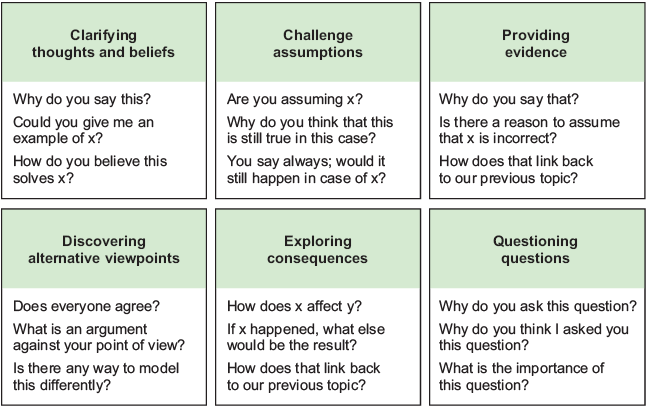
Use the six Socratic-question categories and adaptable prompts to prepare questions that clarify reasoning and test assumptions without deciding who is right. section 5.3.2





