Active listening means giving a speaker your full attention and checking that you understood their message. Listen to their words, tone, body language, and context. Rather than interrupting or assuming you know what they mean, ask questions and reflect their message back. This helps catch misunderstandings before they affect a project. section 7.3.3 section 8.1.1
In a project conversation, try these moves:
- Ask open-ended questions, such as “How do you plan to use the software?” or “What challenge should it solve?” section 8.1.1
- Paraphrase what you heard and invite correction. Clarify unfamiliar terms rather than assuming everyone uses them the same way. section 7.3.3
- Notice tone and body language without treating them as proof. If someone seems uneasy, make room for them to explain their concerns. section 8.1.1
- At the end of a client meeting, recap the discussion and agreed action items. section 8.1.1
Check a feature request before building it
A project manager describes an upcoming app feature. Listen, then repeat your understanding in your own words and ask what you missed. If a requirement remains unclear, ask the project manager or client what they meant. That small check can expose an inaccurate request before it becomes an estimate or implementation. section 7.3.3 section 7.2.1
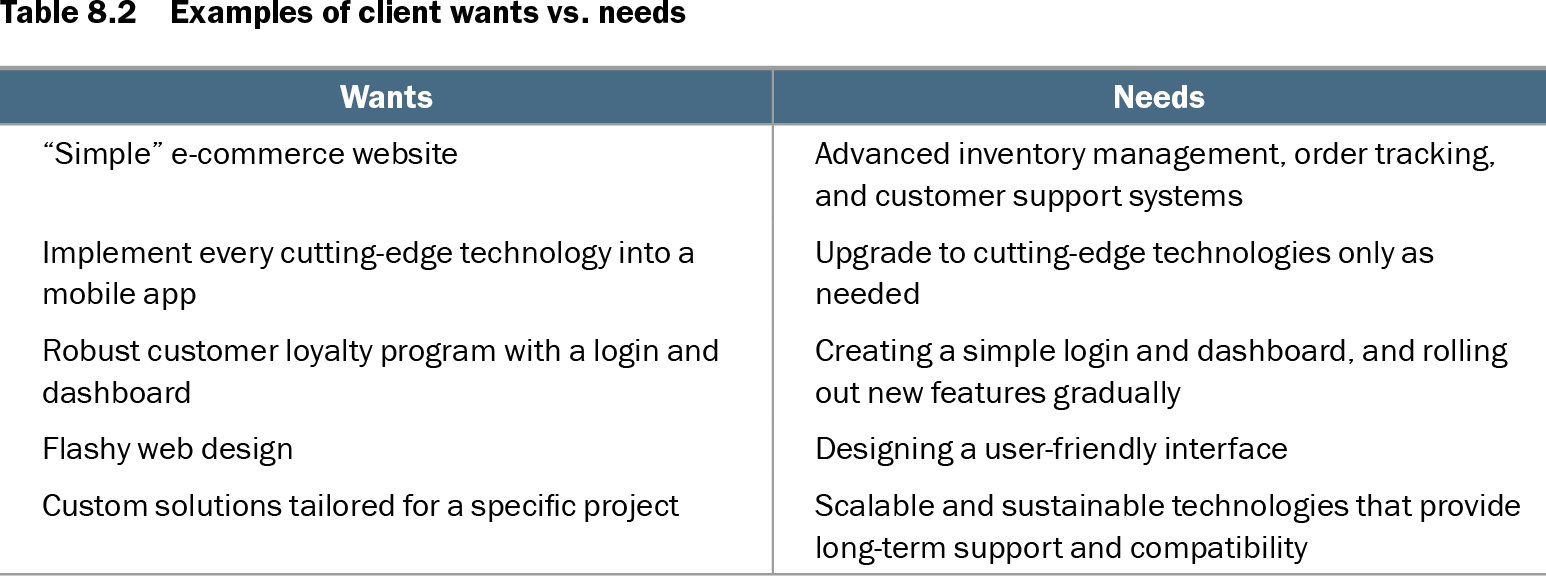
Listening to a client’s preferred solution does not mean agreeing to build it unchanged. Their stated wants can be starting points for questions about business goals, users, and longer-term needs. Interviewing end users can reveal pain points the client does not know about; take notes and bring discrepancies back to the client and project team. section 8.2.1 section 8.1.3
Table 8.2 Examples of client wants vs. needs (view table figure)
| Wants |
Needs |
|---|---|
| “Simple” e-commerce website |
Advanced inventory management, order tracking, and customer support systems |
| Implement every cutting-edge technology into a mobile app |
Upgrade to cutting-edge technologies only as needed |
| Robust customer loyalty program with a login and dashboard |
Creating a simple login and dashboard, and rolling out new features gradually |
| Flashy web design |
Designing a user-friendly interface |
| Custom solutions tailored for a specific project |
Scalable and sustainable technologies that provide long-term support and compatibility |
Compare stated requests with possible underlying needs, then use questions to find out which needs actually apply. The pairs are prompts for discussion, not automatic substitutions. section 8.2.1
Let a frustrated client finish
If a client is unhappy with progress, let them describe the problem even when you disagree. Paraphrase their concern, ask clarifying questions, and work together on a feasible response. Listening can reveal both the source of dissatisfaction and expectations that need clarification. section 8.4.2
The same habit matters within the team. Listen to a developer’s proposed approach before dismissing it; ask probing questions and paraphrase their reasoning. When mentoring, listening with empathy helps you respond to a person’s particular concerns rather than pushing generic advice. Make that attentiveness visible so others can practice it too. section 11.4.2 section 9.1 section 9.3.3