Argparse
argparse is Python’s standard-library module for defining and parsing command-line arguments and generating related usage, help, and error information.

The Quick Python Book, Fourth Edition
argparse is Python's standard-library module for parsing command-line arguments and generating related help and error messages.
- How it is used
- Parses positional arguments and options for command-line scripts, including a wc-style file-counting utility.
- How deep it goes
- Works through parser setup, types, defaults, flags, and Namespace values, then applies optional file handling and stdin.
- Examples
- Uses a report-options script and a wc-style counter with selectable counts and redirected input.
- What you can do after
- Build it from scratch: configure a parser, read its Namespace, and accept either a filename or stdin.
Read how The Quick Python Book, Fourth Edition explains argparse →
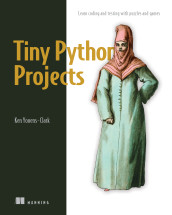
Tiny Python Projects: Learn coding and testing with puzzles and games
argparse is a Python standard-library module for parsing command-line arguments and generating related usage and help information.
- How it is used
- Parses and documents command-line inputs while validating values before program processing.
- How deep it goes
- Explains positional, optional, flag, nargs, choices, type, and file arguments through repeated runnable programs, without internal implementation details.
- Examples
- Uses greeting commands, picnic lists, readable files, dictionary lookups, and vowel substitution to demonstrate argument definitions.
- What you can do after
- Build command-line programs that parse, validate, document, and organize user input with reusable get_args() functions.
Read how Tiny Python Projects: Learn coding and testing with puzzles and games explains argparse →

Django in Action
argparse is a Python standard-library module for parsing command-line arguments and converting them into structured values.
- How it is used
- Parses command-line input for Django management commands and supplies flags or positional values to command logic.
- How deep it goes
- Explains operating-system strings, parser registration, flags, abbreviations, and practical filtering, while deferring argparse’s broader complexity.
- Examples
- Uses a musicians command with name and birth-date filters, abbreviated flags, combined filters, and invalid-date handling.
- What you can do after
- Apply it through Django’s add_arguments() method to register and use management-command inputs.
Related concepts
- modulekind of · A module is a distinct, bounded software unit that groups related code or functionality and provides an organizational or interaction boundary within a larger system.
- command-line argumentuses · A command-line argument is a value supplied to a program when it is invoked, either as positional input or as an option that configures its behavior.
- nargsconfigured by · nargs is an argparse parameter that specifies how many command-line values an option or positional argument accepts.
- parser.error()used by · parser.error() is an argparse parser method that reports a command-line parsing error, displays usage information, and terminates the program with a failure status.
- management commanduses · A management command is a Django command-line operation exposed through Django's management-command system.
These guides are generated from the text of Manning books by Manning's knowledge graph and link to the sections they draw on. The full books are available on liveBook and at manning.com.