Attention selects what matters from context. In language models, attention and feedforward layers build internal representations used to predict the next token; in cognitive agents, attention routes control dynamically among specialized modules. section 2.1.1 section 10.0
A useful contrast is static versus adaptive reasoning. Static reasoning commits to one pattern, while attention lets an agent select, compose, and monitor strategies according to the problem and feedback. section 10.1.2
Use this mental model:
- Represent the current context so the system can make a prediction or choose an action. section 2.1.1
- Route control toward the specialized module or reasoning pattern that fits the problem. section 10.0
- Use evaluation feedback to redirect attention when ambiguity or contradiction appears. section 10.1.2
Redirecting reasoning
An agent begins with one reasoning strategy, but evaluation detects ambiguity or contradiction. Attention redirects control to a different strategy instead of forcing the original pattern to completion. section 10.1.2
Figure 10.2 Cognitive primitives vs. cognitive architecture, with reasoning primitives becoming a selection within the process
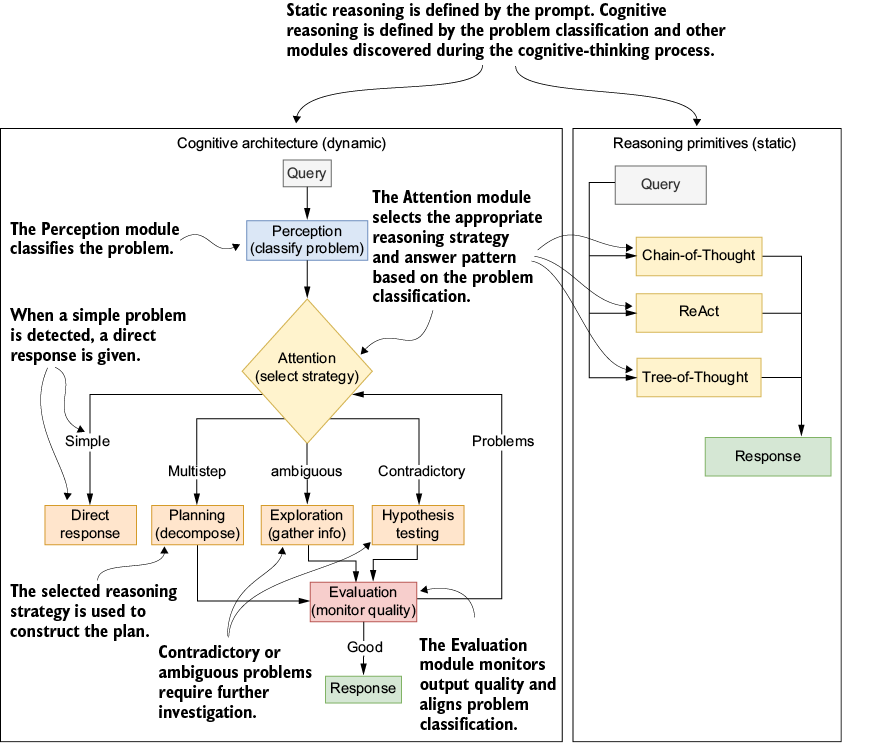
Trace how cognitive architecture turns reasoning patterns from fixed design-time choices into dynamically selected components. section 10.1.2



























