liveBook · Manning

Attention

As explained in Grokking AI Applications

An attention mechanism computes the relative relevance of input elements so a model can focus on the most informative parts of a sequence.

Attention helps a language model focus on the most relevant parts of an input sequence instead of treating every word equally. In transformer architectures, it supports context-sensitive processing by considering both words and their positions. section 1.6

Answering a geography question

For “What is the capital of Italy?”, attention gives greater weight to “Italy” than to “what” or “is”, helping the model predict “Rome.” The model still operates within a limited context window, such as GPT-3’s 2,048-token prompt limit. section 1.6

Figure 1.11 How a GPT architecture generates sentences
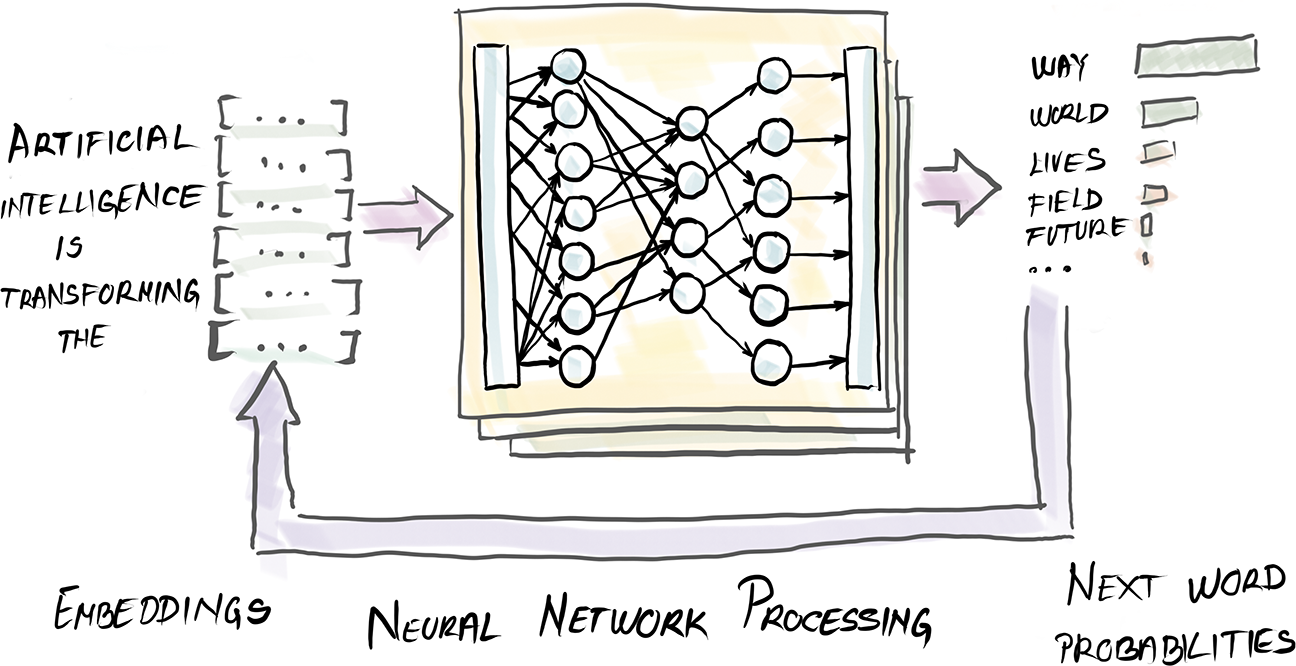
Use the architecture figure to trace how attention contributes to GPT sentence generation. section 1.6

How Grokking AI Applications covers it

How deep it goes
Defines the relevance-focused mechanism and gives one example, but stops short of its neural implementation details.
Examples
Uses the question about Italy’s capital to show why relevant tokens receive greater focus.
What it assumes
Assumes basic familiarity with language models and tokens while introducing transformers, attention, and context windows.
What you can do after
Evaluate how attention helps a language model select informative sequence elements and recognize context-window constraints.
How it connects
Connects attention with transformers, deep learning, positional awareness, context windows, and natural language processing.

Also explained in

Compare how 28 books explain attention →

Related concepts

This explainer was generated by Manning's knowledge graph from the text of Grokking AI Applications. The section links point to the parts of the book it draws on.

























