liveBook · Manning

Backpropagation

As explained in Grokking AI Applications

Backpropagation is an optimization procedure that propagates prediction error through a neural network to adjust its parameters.

Backpropagation is an iterative learning process. A neural network begins with random parameters, makes a prediction, compares it with the expected result, and adjusts its parameters slightly to reduce future errors. section 1.6

A training pass follows three practical stages:

  • Make a prediction using the network’s current parameters. section 1.6
  • Identify whether the prediction is wrong. section 1.6
  • Adjust the parameters slightly and repeat across many training examples. section 1.6
Figure 1.12 The two stages of GPT-3. First, it gets trained, and then the sentence completion is inferred.
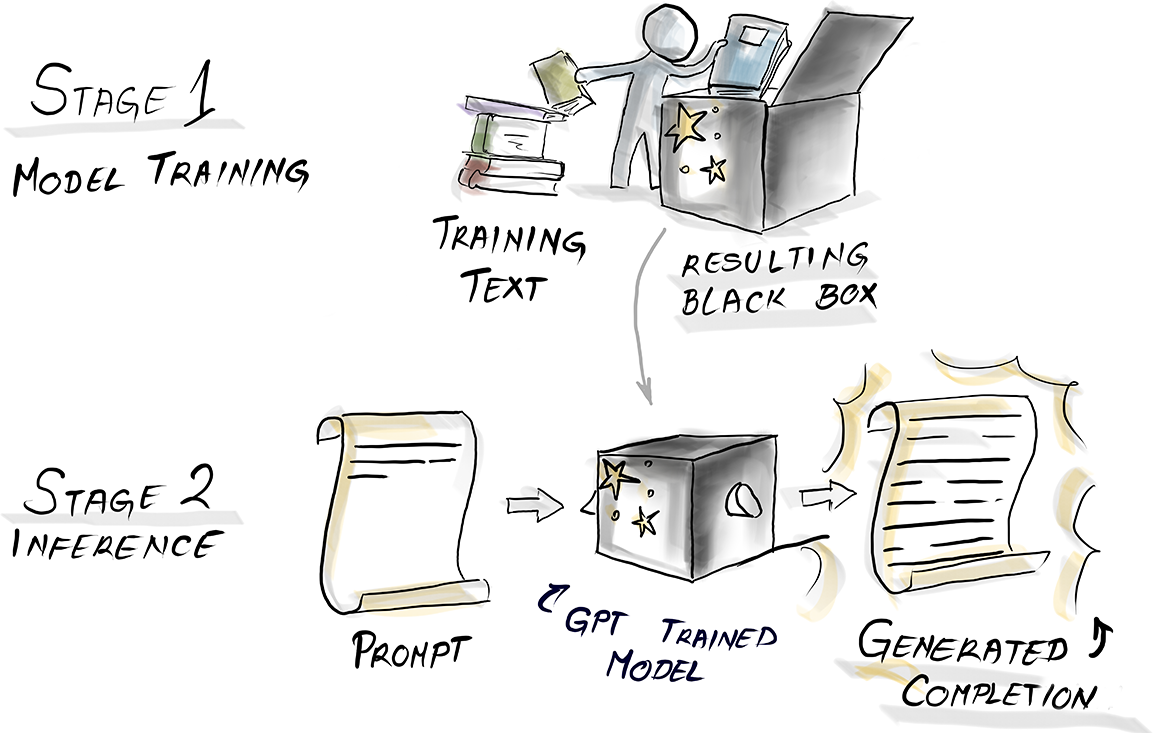
Separates GPT-3’s training stage, where parameter adjustment occurs, from inference, where the trained model completes sentences. section 1.6


How Grokking AI Applications covers it

How deep it goes
Defines the repeated prediction-and-adjustment loop but stops short of mathematical gradients or implementation details.
Examples
Uses student guesses, text completion, GPT-3’s 45 TB dataset, and GPUs as intuitive training examples.
What you can do after
Understand how repeated parameter adjustments reduce errors during neural-network training.
How it connects
Connects neural networks with parameters, training examples, prediction, inference, pretrained models, and GPUs.

Also explained in

Compare how 17 books explain backpropagation →

Related concepts

This explainer was generated by Manning's knowledge graph from the text of Grokking AI Applications. The section links point to the parts of the book it draws on.














