Backpropagation turns prediction error into updates for a neural network’s weights. During language-model training, predictions are compared with target tokens, and the resulting loss guides parameter adjustments alongside Adam or stochastic gradient descent. section 5.2.1
Predicting the next token
A model receives tokenized text and predicts the next word in each sequence. The difference between its predictions and the actual words produces the loss; backpropagation uses that error to adjust the model’s internal parameters. Repeating this process improves predictive accuracy, although large-scale training can take weeks or months. section 5.2.1
Figure 5.2 A simplified version of all the steps necessary to train a language model (large or otherwise) from scratch. You must have data, then define all of the model behavior, and only then proceed to train.
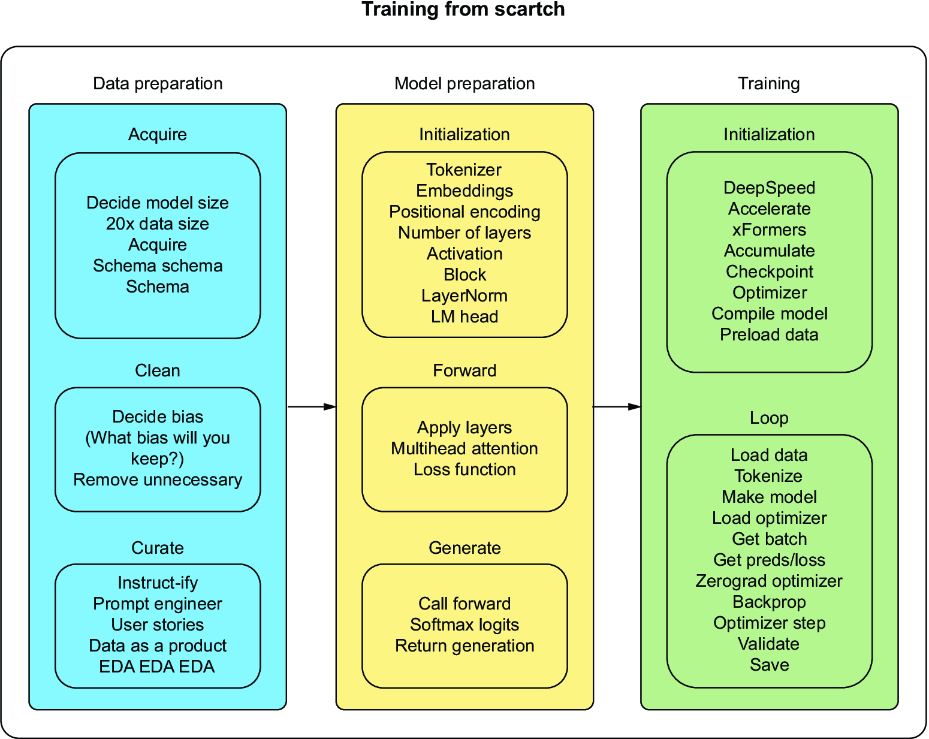
Trace where backpropagation fits in the larger from-scratch workflow: prepare data, define model behavior, then train and validate the model. section 5.2.1
















