Backpropagation mimics learning by changing neural-network weights. After forward propagation produces an output, the network measures its loss and sends responsibility for that error backward. section 5.1.3 section 5.2.4
Each weight receives a gradient: a measure of how strongly that weight affects the output error. The network uses these gradients to adjust weights so the loss decreases. section 5.2.4 section 5.5
A practical mental model is:
- Produce a prediction by propagating inputs forward through connected neurons. section 5.1.3
- Compare the prediction with the correct answer to calculate loss or error. section 5.2.4
- Propagate gradients backward and update each contributing weight in proportion to its effect on the error. section 5.2.4 section 5.5
Learning text patterns with CNN kernels
A convolutional neural network begins with numerical text and uses kernels to detect patterns. Its optimizer learns kernel weights, while backpropagation incrementally adjusts them toward patterns predictive of the target. The pipeline then measures matches, selects maximum responses, and applies an activation function. section 7.2.1
Figure 5.3 Neural network layers
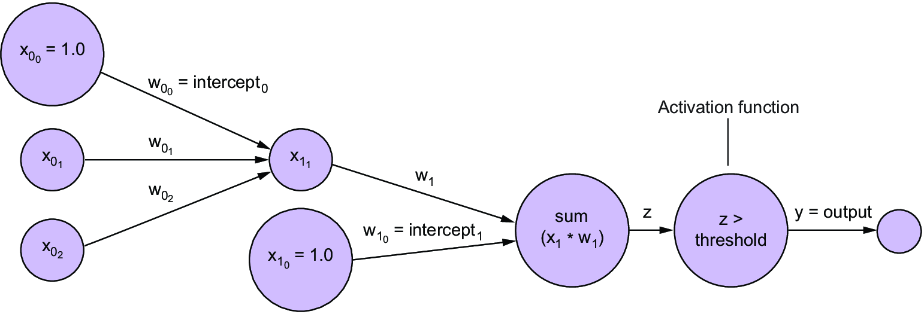
Visualize how predictions from one group of neurons feed into successive layers, creating multiple paths for backward weight adjustment. section 5.1.3
















