A benchmark is a discrete, standardized set of questions or environments used to measure a particular model property. In language-model post-training, benchmarks turn broad goals such as chat quality, knowledge, mathematical reasoning, coding, safety, or tool use into signals that can guide development and compare model behavior. section 16.0 section 16.6
Benchmark design follows the capabilities being pursued. Early chat evaluation emphasized response quality relative to strong models and often used an LLM-as-a-judge; later suites spanned multiple skills; current tasks emphasize difficult reasoning and tool use. A score therefore reflects both model capability and the particular task, prompt format, and scoring procedure used to elicit it. section 16.0 section 16.6
Treat benchmark results as measurements with operational constraints:
- Hold prompts and sampling parameters constant when comparing runs: changing either can produce score shifts larger than small apparent model differences. section 16.2 section 16.6
- Distinguish training, development, and held-out test sets where possible. Public benchmark results may not reveal whether a benchmark influenced training decisions. section 16.2
- Match the evaluation prompt format to the model’s training regime. Few-shot, zero-shot, and chain-of-thought formats can yield sharply different scores, and mismatches can severely reduce performance. section 16.6
- Check for dataset contamination, where evaluation data enters training through web scraping or user queries; n-gram overlap matching is used for decontamination. section 16.6
- Replace saturated benchmarks when they no longer distinguish models meaningfully. section 16.2
Interpreting a small score gap
Two labs report nearby scores on the same public reasoning benchmark. That gap is not a precise ranking by itself: each lab may use different prompts, sampling parameters, inference-time methods, or internal evaluation practices. Treat the scores as rough indicators with meaningful error bars unless the complete setup is controlled and documented. section 16.2 section 16.6
Benchmarks are useful development instruments, but optimizing directly against a fixed suite can encourage hillclimbing and narrow the signal being measured. Evaluation stacks should be chosen for a model’s intended use, maintained as capabilities change, and interpreted alongside their failure modes rather than treated as a hard source of truth. section 16.0 section 16.2
Figure 16.1 Report from Epoch AI showing how major AI evaluations are rapidly saturated over time (saturation is when a given benchmark reaches full performance and models no longer have meaningful signal). License CC-BY.
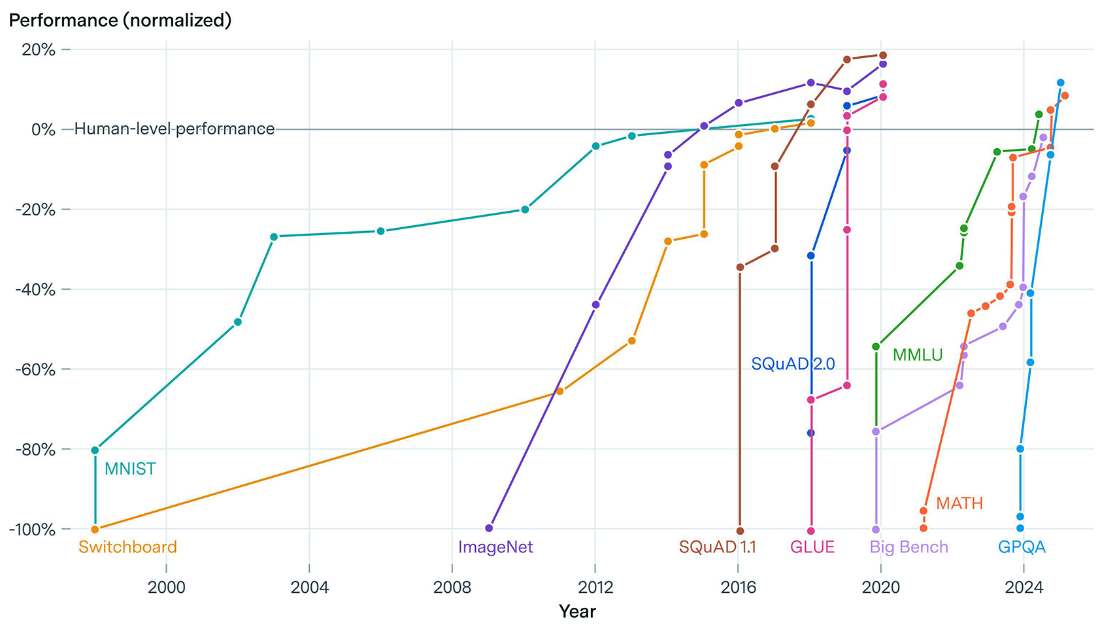
Use the saturation figure to see why a once-challenging benchmark can stop providing meaningful separation between models. section 16.2






















