A benchmark is a defined dataset or task for measuring model performance. It makes comparisons concrete, but a score establishes success on that test—not what intelligence is or whether a model understands as a human does. section 9.3.5 section 9.3.6
Benchmarks can lose their diagnostic value as models improve or encounter test examples during training. ImageNet tracked progress from AlexNet to ResNet before becoming saturated. For language models trained on web-scale data, public datasets such as SQuAD and GLUE may overlap with training material, inflating some results. section 6.2.2 section 6.2.2
Public tests can make evaluation criteria explicit:
- Examples include ARC-AGI, GPQA–Diamond, FrontierMath, SWE-bench, GAIA, and BIG-Bench Extra Hard. section 9.3.6
- Interpret results as performance under stated conditions, not proof of an inner essence or human-like understanding. section 9.3.5 section 9.3.6
Figure 6.5 Line chart (1998–2023) showing multiple series that rise steeply after 2018 toward the “human performance = 0” line for reading comprehension, code generation, math problem-solving, and complex reasoning, indicating rapid benchmark saturation.
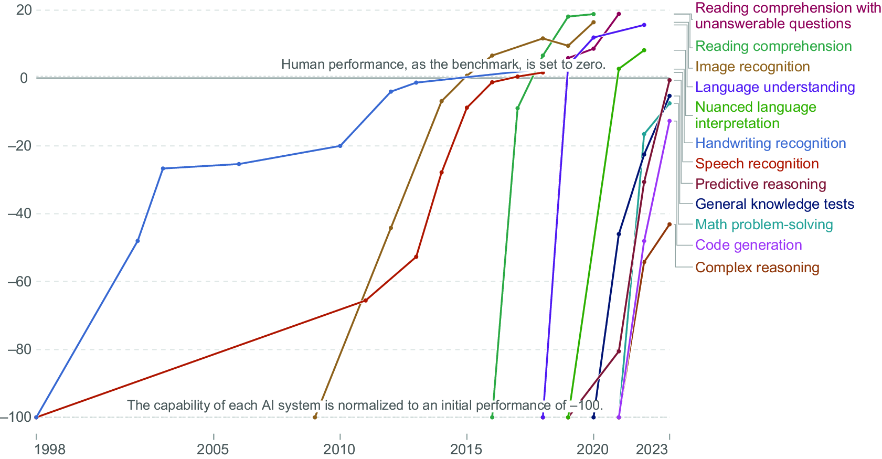
The figure tracks rapid benchmark saturation across several task areas, illustrating why rising scores may eventually stop indicating useful progress. section 6.2.2






















