Caching stores reusable data or computation results in faster-access locations, reducing repeated retrieval and processing. In lakehouse architectures, query engines use local caches, in-memory execution, and adaptive buffering to limit remote reads from durable storage. This makes object storage viable for interactive analytics while shifting performance-sensitive work into the compute layer. section 5.1.1
Design caching around workload and access-pattern tradeoffs:
- Use caching to reduce latency for dashboards, interactive analysis, and other workloads where remote reads would affect responsiveness. section 9.2.1
- Combine caching with query acceleration, reflections, and predictive optimization when federated queries would otherwise repeat scans across remote systems. section 8.3.1
- For AI agents, pair caching with metadata pruning and optimized scan planning to support high-frequency, context-aware queries with low latency and high concurrency. section 9.2.4
- Evaluate cache behavior against concurrency, sequential scans, frequent appends, compactions, and peak reporting or training periods rather than average latency alone. section 5.1.1 section 5.5.1
Federated analytics with Dremio
Dremio caches and accelerates queries across cloud storage, databases, NoSQL systems, and Apache Iceberg, minimizing redundant scans for interactive dashboards and self-service analysis. section 8.3.1
Figure 5.1 Factors to consider in understanding a storage layer’s performance
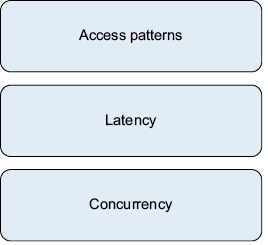
Use the performance-factor diagram to relate caching to data layout, network throughput, access patterns, concurrency, and storage behavior. section 5.1.1





































