Data caching stores copies of previously retrieved or computed data in faster temporary storage, allowing Snowflake to reuse it instead of accessing original storage or re-executing work. section 9.3
Snowflake places caches across its cloud services and query processing layers:
- The query results cache stores executed query results, usually for 24 hours, so repeated queries can retrieve persisted results. section 9.3
- The metadata cache stores database-object metadata, including table row counts and other properties; metadata-only queries can execute without reading table data or using a virtual warehouse. section 9.3
- Each virtual warehouse has a warehouse cache containing data read from underlying tables; subsequent queries may read from it instead of database storage. section 9.3
- Warehouse size determines warehouse-cache size, so larger warehouses provide larger cache areas. section 9.3
Use the query profile when investigating performance: data caching appears alongside micro-partition pruning and data spilling as a significant query-performance scenario. section 8.2.3
Figure 9.7 The three layers of the Snowflake architecture are database storage, query processing, and cloud services. The cloud services layer holds the metadata and the query results cache. The query processing layer holds the warehouse cache for each virtual warehouse.
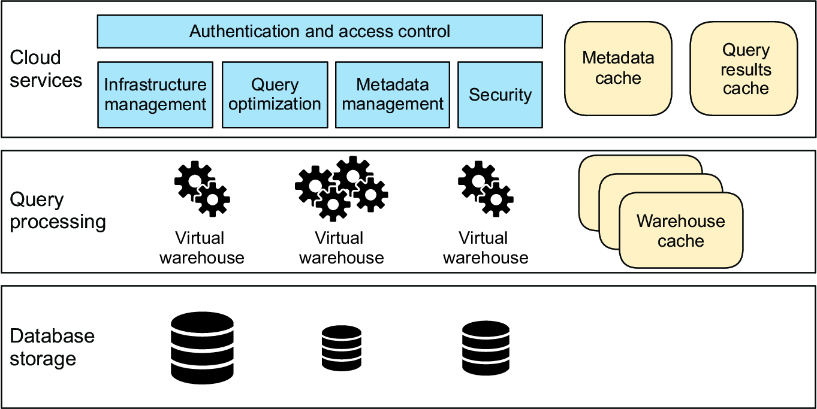
Architecture figure showing database storage, query processing, cloud services, metadata caching, query-results caching, and per-warehouse caching. section 9.3





































