A cache line is a contiguous block of memory that the CPU retrieves into cache as a unit. It includes nearby data, so placing values used together close together can let one retrieval supply several values. section 1.2.3
Figure 1.8 Data is retrieved from main memory in chunks called cache lines. When we ask for data that is not already cached, the CPU retrieves the cache line containing that data. Because the cache line also contains nearby data, the CPU brings those values into the cache at the same time.
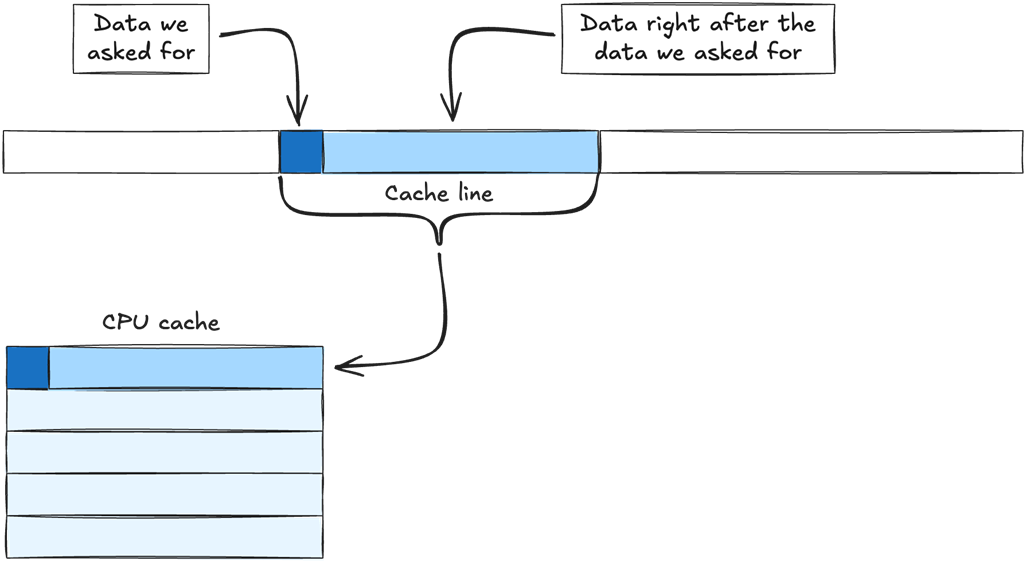
The figure shows how a request brings the containing block—and nearby values—into the cache together. section 1.2.3
Cache-line size depends on the CPU. The examples assume 64 bytes; cited devices range from 32 bytes on a Pixel 4a to 128 bytes on an M2 MacBook Pro. Lines cover fixed, aligned memory ranges. section 1.2.4
Moving enemies
Moving a survival-game enemy uses its position, direction, and velocity. If those values sit next to each other in memory, retrieving one cache line can bring all three into cache together. section 1.2.4




