A canary deployment rolls out a release to a small subset of users or servers, tests the change, and then expands it to the remaining population. The old and new service versions can run simultaneously while traffic rules control exposure. section 15.8 section 4.5.3
A progressive rollout typically proceeds by:
- Deploying the new service version alongside the version already serving most traffic. section 4.5.3
- Directing a predefined traffic share or user segment to the new version. section 4.5.3
- Increasing exposure when the canary shows no problems, then moving all traffic and discarding the old version. section 4.5.3
Traffic-split canary
A service-mesh rule redirects 5% of traffic to the new release of Service A while the remaining traffic uses the established version. A user-agent rule can instead target iPhone traffic specifically. Operations can execute either change on the fly without disrupting end users. section 4.5.3
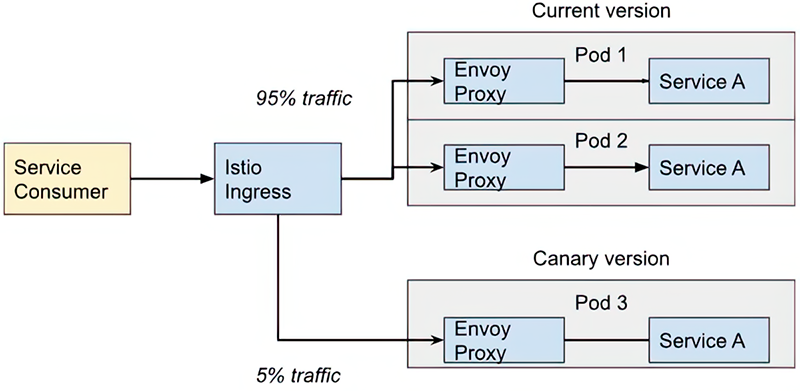
Shows an Istio canary deployment that uses traffic splitting to expose a new service release to a controlled percentage of traffic. section 4.5.3
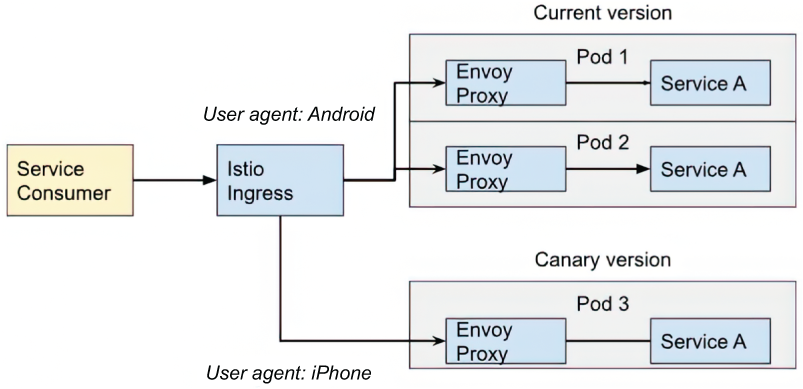
Shows an Istio canary deployment that selects traffic by user-agent, such as iPhone traffic. section 4.5.3






