A canary deployment introduces a new application version to a limited audience before exposing it to everyone. The new version may first serve internal users, then a percentage of external traffic, while its behavior is evaluated before full cutover. section 4.2.3
A canary rollout typically includes:
- Deploying the new version alongside the existing version. section 4.2.3
- Testing the new version with internal users or a small percentage of production traffic. section 4.2.3
- Evaluating results and deciding whether to continue, pause, or complete the cutover; human decisions may be involved. section 4.2.3
- Using traffic-management and deployment tooling when fine-grained routing or automated decisions are required. section 4.2.3
Progressive production exposure
A service keeps the old version available while the new version is tested by internal users. It then receives a percentage of external traffic, remains under evaluation, and proceeds to full cutover only after validation. section 4.2.3
Figure 4.4 A Pod status during a blue/green rollout. Unlike the previous strategies, there are two action points where other systems, potentially including human actors, make decisions.
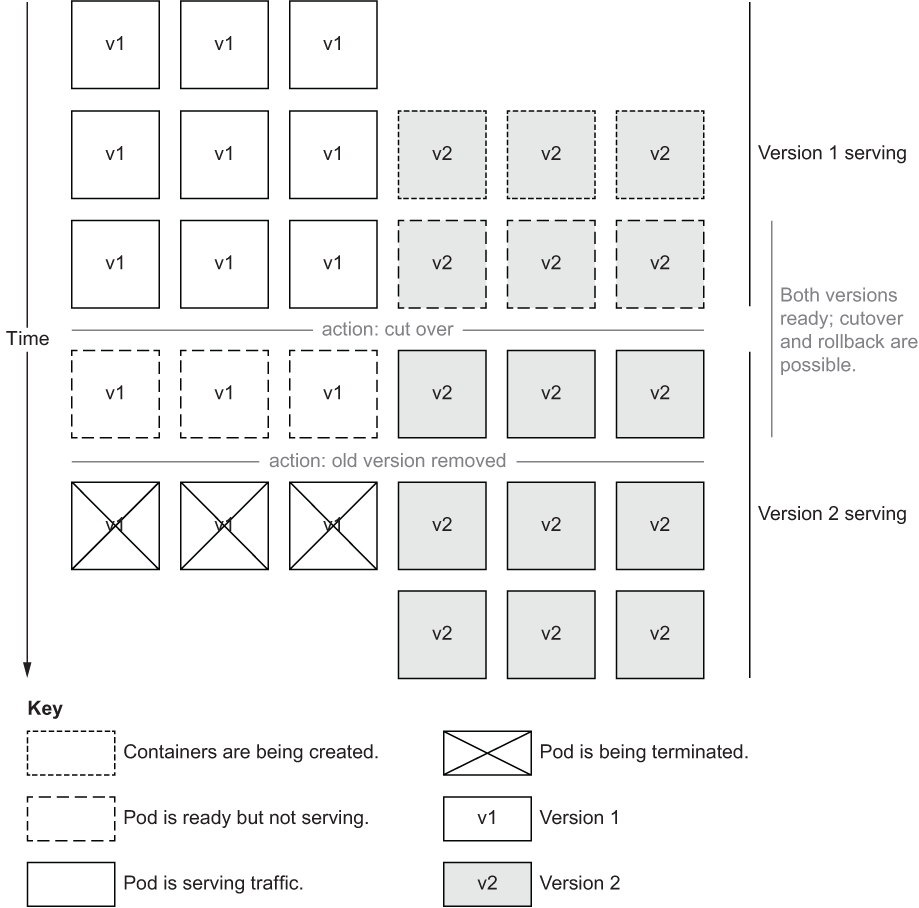
Shows the action points where validation systems or human operators decide whether a staged rollout should proceed. section 4.2.3






