The central limit theorem explains why a sample mean becomes approximately normal as the sample grows, even when the observations’ original distribution is not normal. It requires identically distributed, independent observations with a common finite variance. The sample mean approaches the population mean at rate 1/√n, and its standard deviation is σ/√n. section 8.1.2 section 8.2.2
The result matters because it connects large-sample behavior to practical statistical estimation:
- It provides a benchmark for estimator speed: root-n convergence is achieved by the sample mean and cannot be improved by another unbiased estimator. section 8.1.2
- It supports analytical confidence intervals by approximating the estimator’s distribution with a normal distribution when the sample is large. section 8.2.2
- It describes an asymptotic approximation, so independence, a common distribution, finite variance, and a sufficiently large sample remain important. section 8.1.2 section 8.2.2
From a sample mean to an interval
Suppose x₁, …, xₙ are independently observed. Their sample average and sample standard deviation can be combined with a standard-normal critical value to calculate a confidence interval. This analytical route is faster than bootstrapping when an appropriate formula is available, though such formulas are not available for every problem. section 8.2.2
Figure 8.4 Convergence rate for sequences 1/n and 1/√n. We can see that 1/n converges faster to 0 than 1/√n. The convergence rate of an algorithm tells us how fast this algorithm converges to its objective. In statistics and machine learning, the faster an estimate converges, the less data we need.
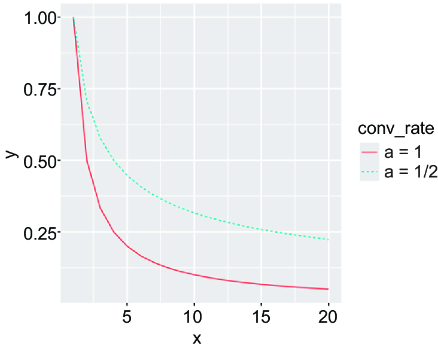
Compare 1/n with 1/√n to see why convergence rate matters for the amount of data needed by an estimator. section 8.1.2


