A label is the correct target value paired with an input example. In supervised learning, labels provide the supervisory signal used to learn a mapping from inputs x to outputs y. section 1.1
Labels determine the prediction task:
- Classification uses discrete labels, such as one of K distinct classes. section 1.1
- Regression uses continuous labels, such as a real-valued stock price. section 1.1 section 6.1
- A dataset represents labels as pairs D = {(x₁, y₁), …, (xₙ, yₙ)}, where each yᵢ is compared with the model prediction. section 1.1 section 6.1
Comparing a prediction with its label
For classification, the loss counts cases where f(xᵢ; θ) differs from the label yᵢ and averages those errors across n examples. The training objective is to reduce this misclassification rate. section 1.1
(1.1)
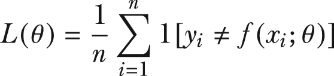
Inspect the classification-loss equation to see how mismatches between predictions and labels become an average error. section 1.1



















