A label is the desired, authoritative output paired with a training input. In supervised learning, these input–output pairs are prepared before training, often by a person who examines each input and assigns its target output. The collection of targets is also called ground truth (GT). section 1.1 section 7.1
Labels give training a direction. For an input x, a model produces a prediction ŷ; training adjusts parameters so ŷ approaches the corresponding label y. With squared error, a single-example mismatch is (ŷ − y)², and total training error aggregates such mismatches across the dataset. Thus labels are not model inputs or learned parameters: they are the reference outputs used to judge predictions. section 1.3.5 section 2.5.4
A label’s form follows the task’s output type:
- Regression uses a numeric target, such as the actual number of mobile phones sold in a week. section 8.5
- Classification uses one member of a prespecified set of classes, such as face versus not face or one of several cat-brain decisions. section 1.5 section 7.2.2
- Object detection assigns a class label to a proposed region and also uses ground-truth bounding boxes to derive localization targets. section 11.4.3
- Image reconstruction can treat the original input image as the ground-truth vector against which the reconstructed output is compared. section 9.1.4
From annotated points to a decision boundary
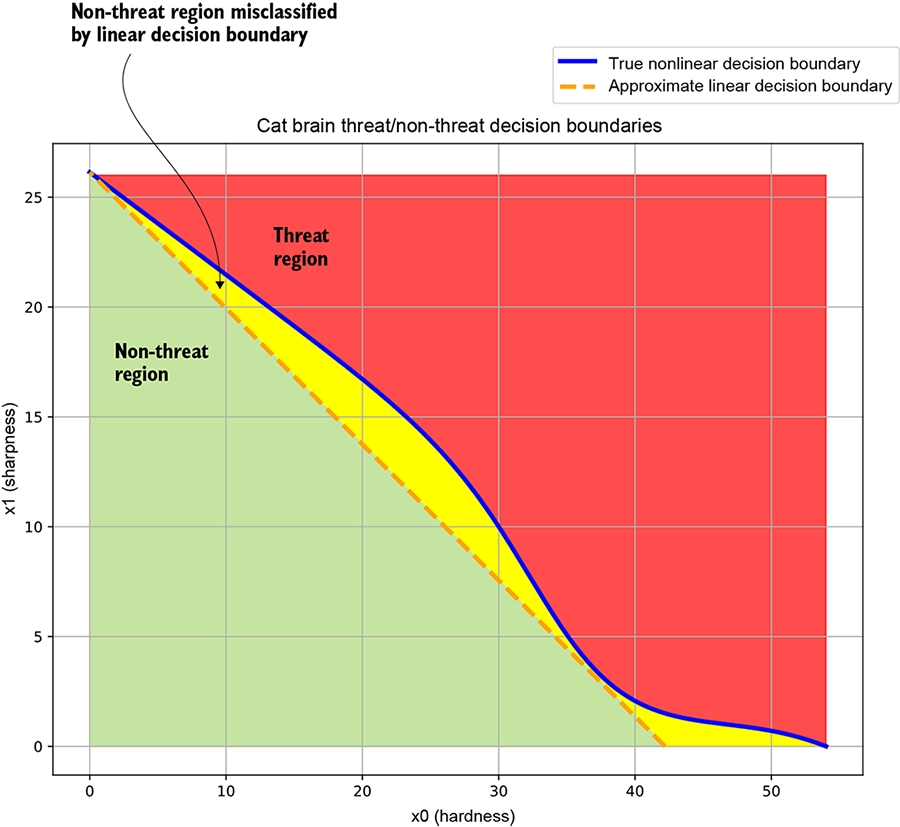
Suppose examples are points described by hardness and sharpness. Manual labeling marks sampled points as threatening or nonthreatening. A classifier uses these labels to place a decision boundary between the two regions. Labels that span each class’s region support a better boundary; sparse or unrepresentative labeled samples can produce a bad one. section 7.2.2
Because manual annotation is costly, supervised learning depends on the availability and quality of labels. Unsupervised methods use inputs without manually labeled ground truth; semi-supervised methods label only a fraction of the data; self-supervised methods create labels programmatically. When classes are imbalanced, focal loss can emphasize examples whose predictions remain far from their labels rather than already-easy examples. section 7.1 section 9.1.7
Figure 7.4 Classifiers, decision boundaries, and training data. Data points from different classes are marked with different symbols (plus and dot).
|
(a) Cat brain threat model decision boundary. The solid curve corresponds to the true decision boundary separating the threat and non-threat regions. The dashed line represents an approximate linear decision boundary: it classifies most points correctly but misclassifies points in the region between itself and the true decision boundary. |
|
(b) Good training data. Sample points from each class roughly span the region of input space belonging to the class. This yields a good decision boundary (solid line). |
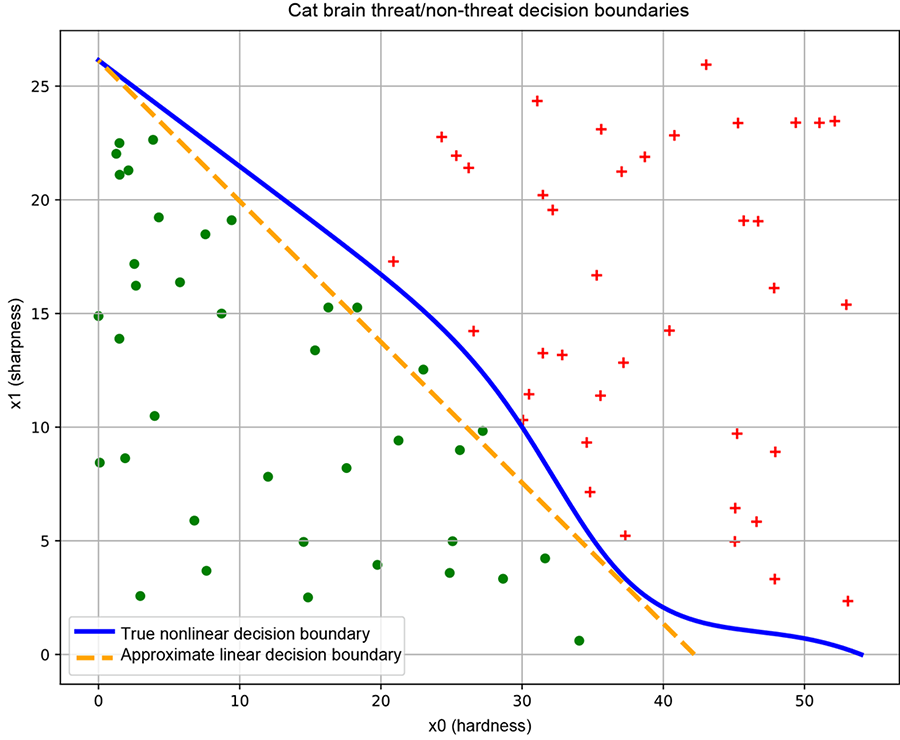
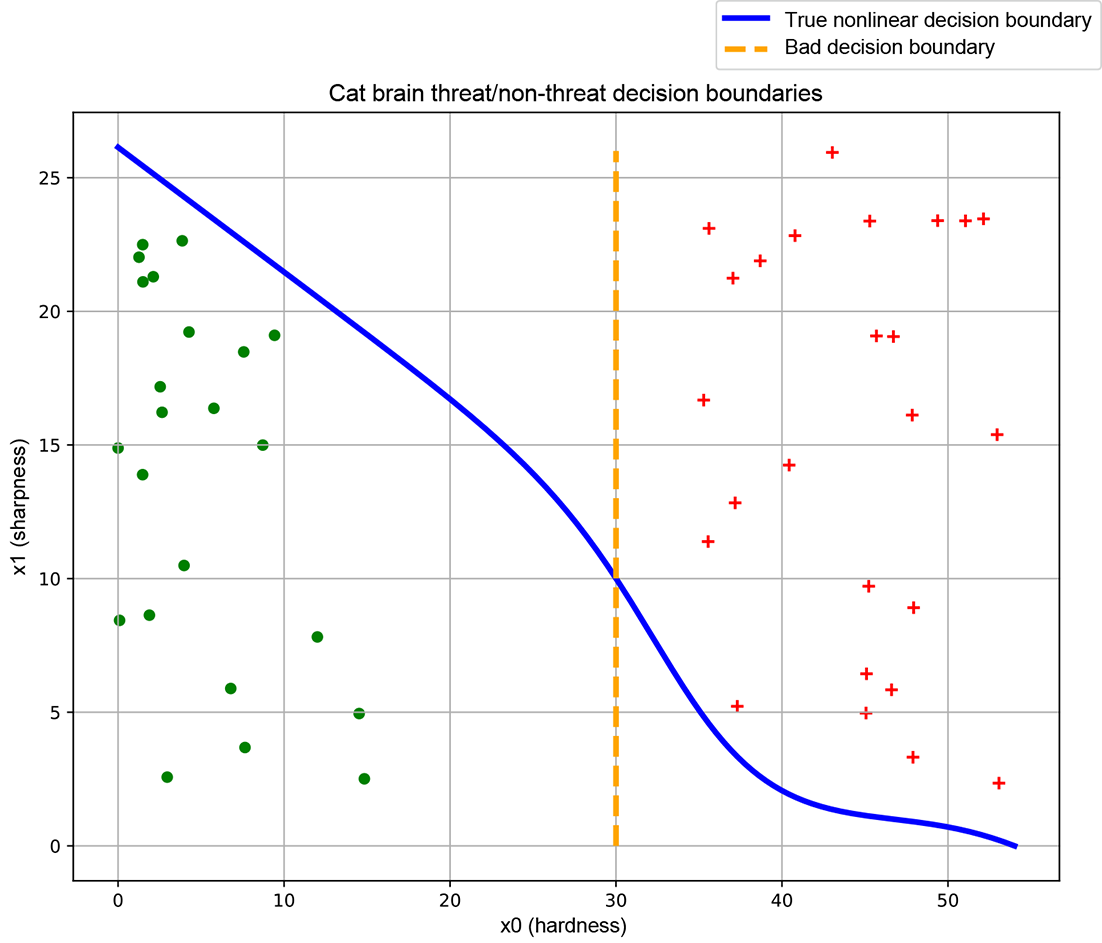
Compare labeled samples with the resulting decision boundaries to see why coverage of each class region matters. section 7.2.2



















