liveBook · Manning

Cloud computing

As explained in Fast Python: High performance techniques for large datasets

Cloud computing is a model for on-demand network access to shared computing resources and services that can be provisioned and scaled as needed.

Cloud computing shifts data processing from a local computer or organization-managed cluster to externally maintained infrastructure. Servers may be virtual, and serverless computing can remove the need to manage servers directly. section 1.2.3

Cloud performance depends on more than adding compute or storage. Proprietary services have specific APIs and behaviors; virtualization can make CPU optimizations such as cache-locality tuning less predictable. Because cloud costs depend on time, inefficient computation can also cost more. section 1.2.3

Figure 1.4 Underlying hardware architectures must be taken into account when choosing high-performance coding solutions.
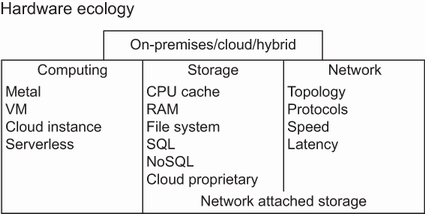
Relates architecture choices to the hardware and system context that shapes performance. section 1.4


How Fast Python: High performance techniques for large datasets covers it

How deep it goes
Explains virtualization, proprietary services, and cost implications, but stops short of implementation details for specific cloud APIs.
Examples
Uses serverless computing and virtual-machine cache preemption to illustrate cloud infrastructure and performance effects.
What you can do after
Evaluate architecture trade-offs and choose performance strategies suited to available resources and goals.
How it connects
Connects cloud computing with virtualization, serverless computing, CPU cache locality, and cluster computing.

Also explained in

Compare how 11 books explain cloud computing →

Related concepts

This explainer was generated by Manning's knowledge graph from the text of Fast Python: High performance techniques for large datasets. The section links point to the parts of the book it draws on.








