Cloud computing shifts part of a system’s management to another entity, such as an internal team, outside provider, or automation system. It reduces manual server management by abstracting infrastructure and making resources programmable. section 12.1 section 12.1.1
The main service models differ by which parts of the stack remain under the consumer’s control:
- Infrastructure as a Service (IaaS) provides programmable virtual servers, storage, networking, and related infrastructure. Consumers manage the operating system, runtime, application, and data. section 12.1.1
- Platform as a Service (PaaS) accepts application code and supporting metadata, such as the implementation language, through an API; the platform builds and runs the application environment. section 12.1.1
- Traditional bare-metal deployment leaves the entire stack under the organization’s control, including hardware acquisition, connection, and management. section 12.1.1
IaaS resources are created and destroyed as needed through programmable interfaces, typically REST APIs or command-line tools. This makes infrastructure operations part of application deployment and management rather than a sequence of manual hardware tasks. section 12.1.1
Figure 12.1 The types of cloud computing
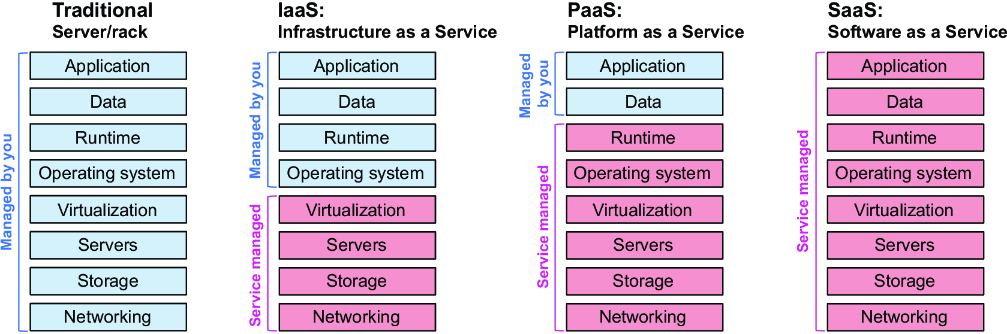
Compare bare-metal deployment, IaaS, and PaaS by the portion of the stack managed by the provider or consumer. section 12.1.1









