A caller can reach the end of a claim search and still leave without the claim details they needed. Completion rate, also called task completion rate or success rate, is the proportion of user tasks completed successfully. Define “completed” around the user’s goal, not merely around whether the bot finished a step. section 8.1.2 section 3.3.2
Claim status: search is not completion
A claim-status voice flow initially succeeded only 40% of the time. It asked for five pieces of information before searching, including a claim number that most callers did not need to provide. The revised flow searched with less information and asked for the claim number only when it found multiple claims. Task completion improved, and claim-number search failures fell by half. A further problem remained: after finding a claim, the bot offered to read or fax the details instead of simply reading them. Delivering the details immediately better matched what callers came to do. section 8.1.1 section 8.1.2
Completion depends on the steps leading to the outcome. In a process flow, users must engage, be understood, and receive what they need; losses at each step narrow the group that finishes. Examine where users retry, abandon, or request an agent rather than treating a low overall rate as a single problem. section 1.3.1 section 8.1.1
Figure 3.10 Enhancing the summary dashboard with a success rate. Not all contained calls are successful; not all transferred calls are failures.
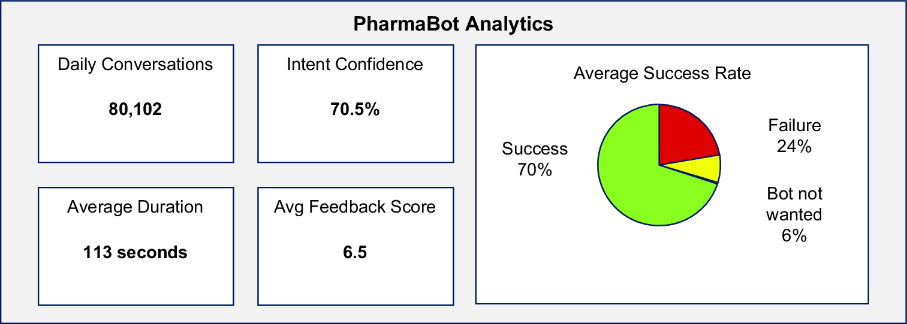
The success-rate dashboard distinguishes completion from containment: a contained call is not necessarily successful, and a transfer is not necessarily a failure. section 3.3.2
Set success criteria for each use case and business objective. Classify outcomes so an intended transfer is not mistaken for failure, then connect changes in completion rate to particular flow changes. For example, an opt-out retention design helped raise overall use-case completion from 27% to 30% when combined with other updates; that change should not be credited to retention alone. section 8.1.2 section 3.3.2 section 11.4.2

