Compliance keeps AI web applications aligned with data-privacy, intellectual-property, content-authenticity, and organizational requirements. It is especially important when applications collect, store, or process personally identifiable information (PII), such as names, addresses, phone numbers, emails, financial details, or medical information. section 1.6.1 section 9.5
Build compliance into the security and data-protection pipeline:
- Identify sensitive chat data, including PII, financial details, and medical information, then apply stronger protections to more sensitive content. section 9.5
- Obtain user consent for PII collection, store it securely, and provide mechanisms for users to request deletion. section 1.6.1
- Use encryption for sensitive stored data, least-privilege access controls, and strictly limited, logged impersonation when authorized users review another user’s history. section 9.5
- Define retention periods from legal and business needs, permanently delete expired data, and let users download their chat histories. section 9.5
- Avoid putting PII in prompts or sending sensitive details to language models without compatible PII policies; consider anonymization or pseudonymization for analysis and training. section 9.5
- Combine authentication and authorization, API-key management, rate limiting, data security, and auditing to reduce abuse and protect provider resources. section 9.2
A compliant chat-history workflow
A chat application evaluates whether histories contain PII or financial information, encrypts sensitive records, restricts access by role, logs temporary review access, applies a stated retention period, permanently deletes expired records, and gives users a download and deletion path. section 9.5
Figure 9.2 A layered approach covering secure development practices, authentication and authorization, API key management, data protection, and compliance to ensure robust security and threat prevention
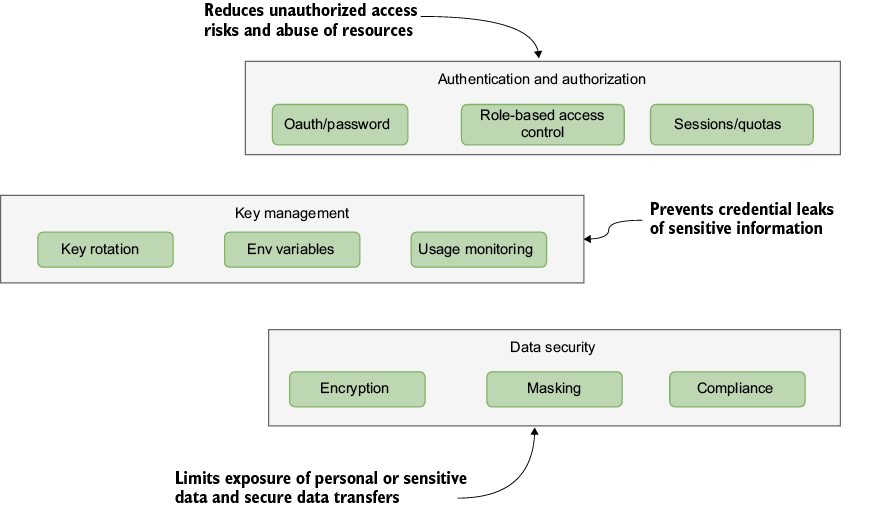
A layered security view connects compliance with secure development, authentication and authorization, API-key management, data protection, and threat prevention. section 9.2











