A control point is a point whose position influences the shape or position of a spline or other parametric geometric representation. Bézier curves use control points to determine tangents, while NURBS use arrays of control points to guide curves and surfaces. section 7.2.4 section 7.3
Control points participate in several related design choices:
- Increasing the NURBS degree trades the number of curve segments for continuity: N control points produce N−M segments of degree M with C(M−1) continuity. section 7.3.1
- A knot vector determines parametric distances and can make selected control points interpolating rather than merely shaping the curve. section 7.3.2
- Rational NURBS add weights, providing additional control for engineering curves and three-dimensional surfaces. section 7.2.4 section 7.3.5
Unbending a photographed page
A scanning application can let a user move control points over a bent page. A linear interpolation along one axis and cubic interpolation along the other then maps a standard square onto the photograph, preserving straightness in one direction while allowing bending in the other. section 8.1.3
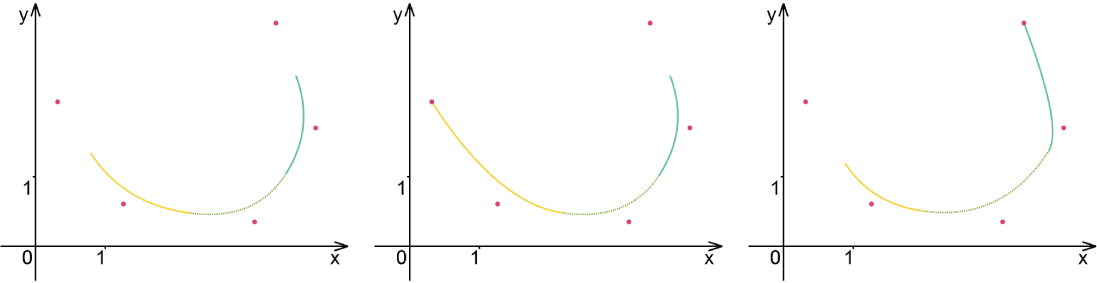
Compare curves formed from identical control points but different knot vectors; the resulting interpolation and shaping behavior changes. section 7.3.2