Covariance measures how two random variables vary together. It links variance, correlation, and regression, while causal diagrams show that correlation can propagate along confounder, mediator, and collider structures differently from causal effects. section 6.2.2
Useful identities connect covariance to common statistical calculations:
- Variance is self-covariance: var(X) = cov(X, X). section 6.2.2
- Scaling gives var(aX) = a² var(X), while covariance distributes across linear combinations: cov(aX + bY, Z) = a cov(X, Z) + b cov(Y, Z). section 6.2.2
- For a regression M ~ R, the slope is cov(M, R) / var(R). With standardized variables, covariance equals correlation. section 6.2.2 section 9.2.1
Covariance in instrumental variables
An instrumental-variable calculation uses cov(D, Z) / var(Z) for the regression D ~ Z and cov(Y, Z) / var(Z) for Y ~ Z. Dividing these coefficients cancels var(Z), producing the ratio cov(Y, Z) / cov(D, Z) for the causal-effect estimator described by the model. section 9.2.1
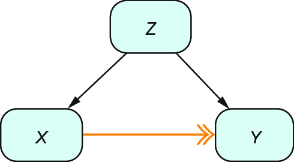
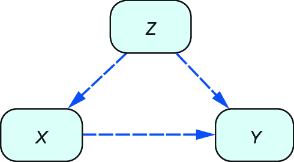
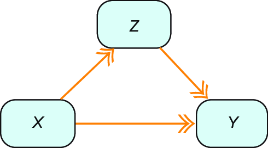
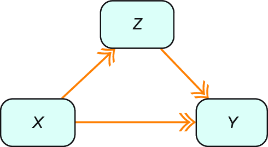
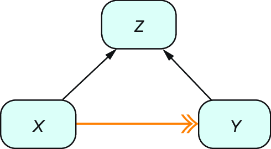
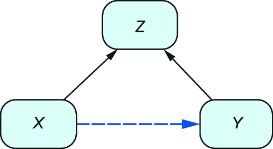
Table 6.12 Differences between causal paths (dashed lines) and correlation propagation (double-headed arrows)
|
Case
|
Causal paths
|
Correlation propagation
|
|
Confounder
|
|
|
|
Mediator
|
|
|
|
Collider
|
|
|
Compare confounder, mediator, and collider cases to see how causal paths differ from correlation propagation. section 6.2.2




