liveBook · Manning

Cross entropy loss

As explained in Experimentation for Engineers

A loss metric that measures the discrepancy between a probability distribution predicted by a model and the observed outcome distribution.

Cross-entropy measures prediction quality by comparing a model’s predicted probability distribution with observed outcomes. Out-of-sample cross-entropy can improve while the intended business metric stagnates, so it is not automatically a sufficient optimization target. section 7.1.1

Video recommendation

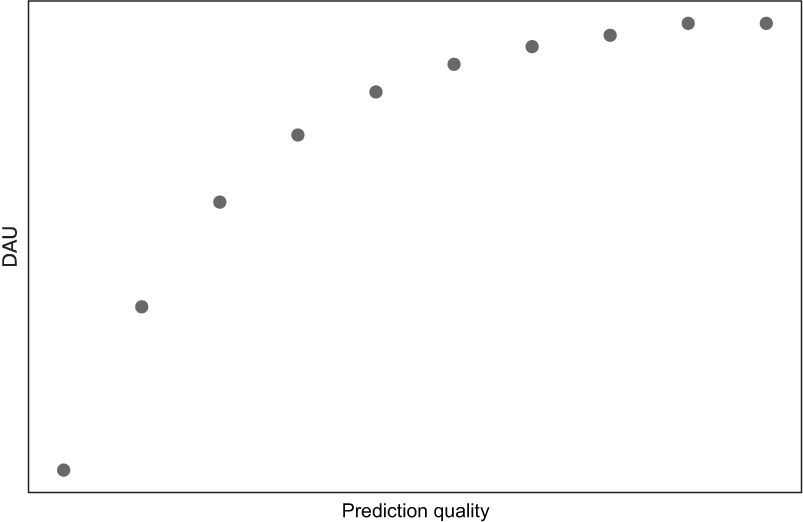
A model predicts P{swipe} from video features, then ranks videos by predicted swipe probability. Early improvements in out-of-sample cross-entropy coincide with higher DAU, but later improvements produce diminishing gains and eventually no DAU improvement. The engineering failure is optimizing the generic prediction metric without validating its connection to the business outcome. section 7.1.1

Figure 7.1 As the quality of the predictions, P{swipe}, produced by your ML model increases, the DAU increases, too, but at an ever-slower rate.
07-01

Shows prediction quality improving while DAU rises at an increasingly slower rate. section 7.1.1


How Experimentation for Engineers covers it

How deep it goes
Defines the metric through a production example but stops short of giving its formula or implementation.
Examples
Uses video swipe probabilities, feature-based ranking, successive model versions, and DAU outcomes.
What it assumes
Assumes familiarity with ML predictions, probability estimates, features, A/B tests, and business metrics.
What you can do after
Evaluate whether prediction improvements translate into the intended business metric rather than assuming correlation.
How it connects
Connects prediction quality with business metrics, A/B testing, recommendation ranking, and DAU.

Also explained in

Compare how 19 books explain cross entropy loss →

Related concepts

This explainer was generated by Manning's knowledge graph from the text of Experimentation for Engineers. The section links point to the parts of the book it draws on.















