Cross-entropy loss measures the discrepancy between a target probability distribution and a model’s predicted distribution. During training, it serves as a smoother proxy for accuracy, which changes in discrete jumps and is difficult to optimize directly. section 4.1.1
Why use a proxy?
If a model predicts cancer cases, the correct count might be 48, but actual cases cannot be 48.2. Accuracy therefore produces a nonsmooth target, while cross-entropy provides a better-behaved training objective. The trade-off is that training may optimize what is easy to learn rather than exactly what people want. section 4.1.1
Figure 4.2 Examples of a smooth function on the left and two nonsmooth functions on the right. The center example is mostly smooth, but one region is not smooth because the function has no value. On the right, the function is not smooth anywhere due to the hard change in value.
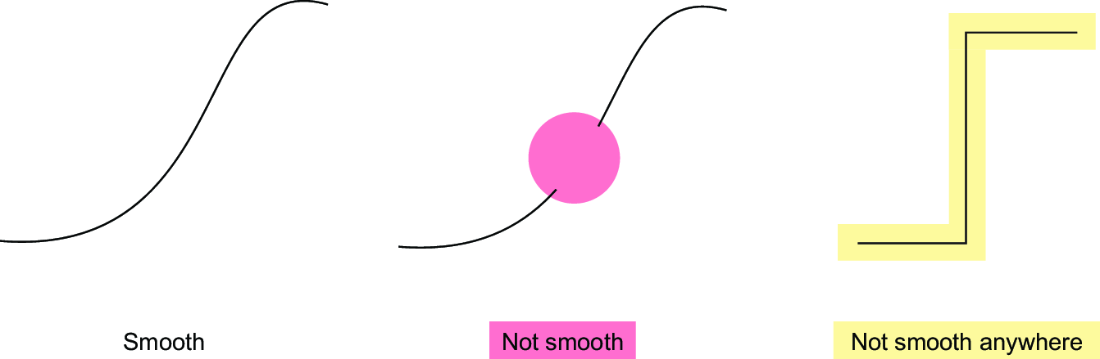
Compare smooth and nonsmooth functions to see why training objectives need to change gradually rather than jump between values. section 4.1.1


















