liveBook · Manning

Curse of dimensionality

As explained in How Large Language Models Work

The curse of dimensionality is the phenomenon in which increasing the number of dimensions causes the space, data requirements, and computational costs to grow substantially.

Adding dimensions lets embeddings represent subtler relationships, but it also increases memory, computation, semantic-space size, and training requirements. section 3.2.1

From one number to several

Representing words with one number quickly makes relationships nonsensical. Two or more numbers provide room to place similar meanings near one another, while increasing dimensions makes the space harder and costlier to learn. section 3.2.1

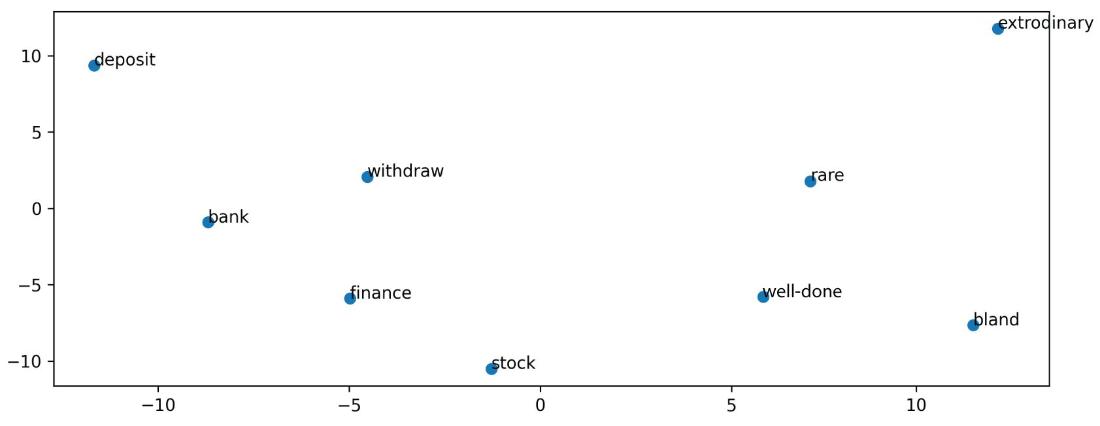
Figure 3.4 Adding another dimension to our token representation allows us to represent a more diverse arrangement of semantic relationships. Here we see how two dimensions can capture relationships for multiple meanings of the same word.
figure

Use the figure to see how an additional dimension accommodates more diverse semantic relationships and multiple meanings. section 3.2.1


How How Large Language Models Work covers it

How deep it goes
Defines the phenomenon and traces its main costs, but stops short of mathematical derivation or quantitative analysis.
Examples
Uses one- and two-number word representations to show why added dimensions improve semantic relationships while expanding the space.
What it assumes
Introduces embeddings, vectors, dimensions, and semantic space while assuming only basic familiarity with token representations.
What you can do after
Evaluate embedding choices by weighing richer relationships against storage, computation, and data requirements.
How it connects
Connects embeddings with vectors, dimensions, semantic space, latent space, and machine learning models.

Also explained in

Compare how 7 books explain curse of dimensionality →

Related concepts

This explainer was generated by Manning's knowledge graph from the text of How Large Language Models Work. The section links point to the parts of the book it draws on.




