Data is a collection of facts, observations, measurements, text, numbers, images, and videos. It may be ordered or unordered, clean or unclean, and uniform or mixed in type. Data becomes useful after cleaning, organizing, analyzing, and interpreting it. section 1.2.1
Working with data involves several connected concerns:
- Generate data through activities such as mobile calls, banking transactions, online bookings, social media use, and shopping. section 1.2.1
- Manage data by storing, exporting, loading, transforming, measuring, cleaning, and organizing it. section 1.2
- Classify data as structured datasets with row-column organization or unstructured datasets such as text and images. section 1.7
- Assess quality through completeness, validity, accuracy, representativeness, availability, consistency, timeliness, and integrity. section 1.7
- Transform raw data into information, knowledge, and actionable insight by finding distinctions and connecting relationships. section 1.2.1
From observation to action
A telecom analysis can reveal that customers who make no calls for nine days have a 30% higher churn risk. A manufacturing analysis can show that mold X produces 60% more defects than mold Y. Both findings turn data into corrective business action. section 1.2.1
Figure 1.1 How we can transform raw data to become information, knowledge, and, finally, insights that can be used in business to drive decisions and actions
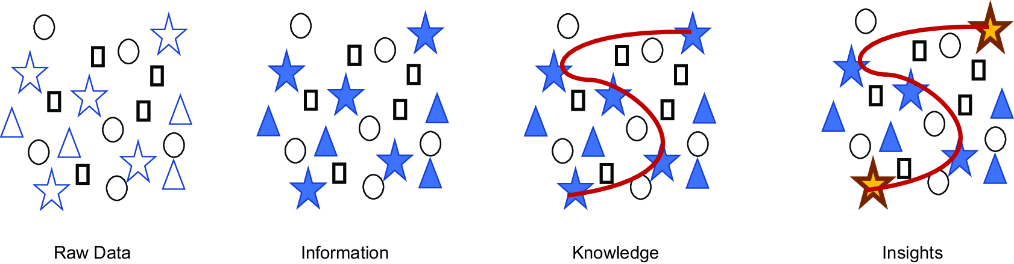
Follow the progression from raw data through information and knowledge to insights that support business decisions and actions. section 1.2.1







