Data is the raw material that turns an AI capability into product value. It fuels training, fine-tuning, evaluation, and model inputs, but quality alone is not enough: coverage, bias, and alignment with real user needs determine whether the experience works in practice. section 1.3.2 section 3.1
Treat data as part of the solution space alongside intelligence and user experience. Choose data according to the task: modalities include text, visual, and auditory data, while labeled data supplies learning signals for supervised learning and unlabeled data supports unsupervised learning. section 3.1 section 3.4
Use these checks when shaping an AI product:
- Align training and test data with realistic user requests, not only with an abstract model objective. section 1.3.2
- Check whether the data covers important cases and whether bias or misalignment could damage user outcomes. section 1.3.2
- Select the data and learning approach together with the problem, rather than defaulting to the newest model. section 3.0 section 3.4
- Manage data from the beginning as a potential strategic advantage, while addressing privacy, fairness, and governance constraints. section 1.3.2 section 1.5
From questions to useful queries
A conversational financial-data assistant uses pairs of natural-language questions and corresponding SQL queries as training and test data. When those examples fail to reflect actual requests, the model can collapse under real user demand; representative examples help connect model behavior to the intended product experience. section 1.3.2
Choosing proportionate data and models
A movie platform initially sends every review to GPT-4o with a lengthy few-shot prompt for sentiment analysis. A small logistic-regression model provides a faster, less expensive alternative that can run on the company’s own infrastructure. section 3.0
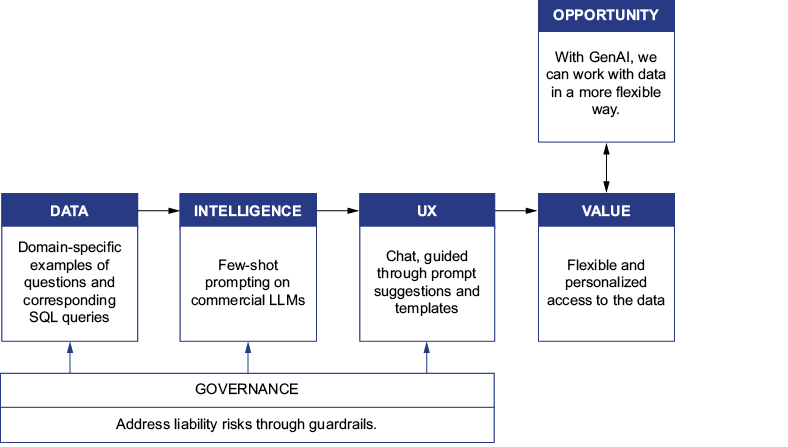
Use the mental model to see how data connects with intelligence, user experience, and governance in a conversational financial-data assistant. section 1.3.2







