Data integrity preserves accuracy, completeness, consistency, and recoverability throughout a lakehouse data lifecycle. In Apache Iceberg architectures, integrity depends on both durable physical files and coordinated transactional metadata. section 5.1.3
Assess integrity as an architectural requirement rather than a vendor feature:
- Require durability against hardware failures, network interruptions, unexpected shutdowns, corruption, and data loss; compare replication, consistency, and recovery guarantees. section 5.1.3
- Plan backups and disaster recovery with versioning or point-in-time snapshots, restoring Iceberg data files together with manifests, snapshots, and metadata files. section 5.1.3
- Evaluate integrity alongside performance, security, cost, and operational complexity, using organizational constraints instead of marketing claims to shortlist storage systems. section 5.1 section 5.5
- Use erasure coding, self-healing, georeplication, WORM enforcement, or strong consistency where deployment conditions require additional resilience. section 5.5.3
Intermittently connected edge deployment
An industrial IoT platform stores Iceberg tables across nodes with unreliable network connections. MinIO or Ceph can provide local durability and consistency through erasure coding and self-healing until the next synchronization window. section 5.5.3
Figure 5.3 Integrity factors to consider when assessing a storage system
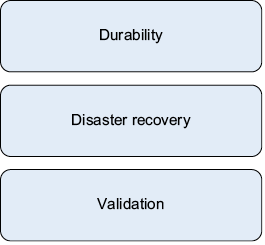
Use the integrity-factors diagram to compare durability, recovery, consistency, and related storage considerations. section 5.1.3

















