DevOps is an organization-wide way of working: a set of principles and practices for delivering software quickly and reliably, not a team name or job title. section 1.1.3
The three ways describe its foundational principles:
- Move changes quickly from development into production. section 1.1.3
- Return feedback quickly from production to development. section 1.1.3
- Build a culture of continual experimentation and learning. section 1.1.3
Figure 1.3 Fast flow requires a combination of three elements: DevOps as the development process, an organization structured using the Team Topologies patterns, and an architecture that enables DevOps and Team Topologies.
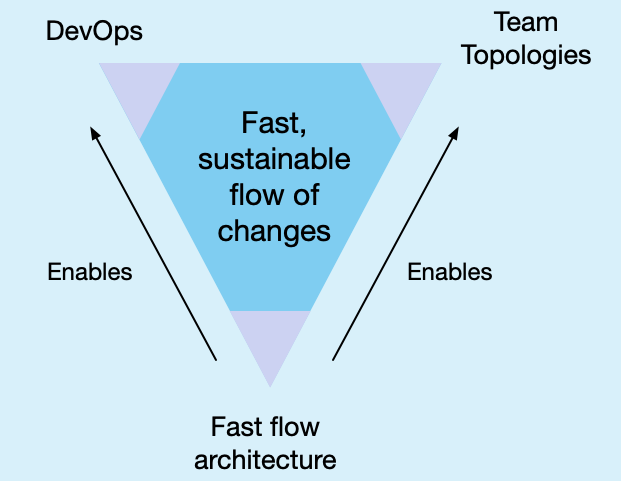
The fast-flow success triangle places DevOps alongside Team Topologies and architecture that enables both. section 1.1.3
DevOps is one part of fast flow, not a substitute for suitable organization and architecture. Before migrating a slow monolith to microservices, adopt DevOps and Team Topologies and establish an automated deployment pipeline; migrate only if these changes are insufficient and the architecture is the root cause. section 1.2 section 1.4.2