An epoch is one complete pass through every example in a training dataset. Fine-tuning repeats this process so the model can update its parameters, while validation data helps reveal whether additional passes improve generalization or encourage overfitting. section 9.3.1 section 9.3.4
Use the epoch count as one training control alongside dataset quality and other hyperparameters:
- Increase or reduce the number of epochs while monitoring validation performance; training loss alone can hide overfitting. section 9.3.1 section 9.3.4
- Interpret a good fit as training and validation loss decreasing toward stability with only a small gap between them. section 9.3.4
- Treat the epoch count as a production trade-off: insufficient training can underfit, whereas excessive training can reduce performance on unseen data. section 9.3.4
Setting epochs for an Azure OpenAI fine-tuning job
The fine-tuning request sets n_epochs to 3 while selecting GPT-3.5 Turbo 0613. The job is queued, so its status should be tracked until it succeeds or fails. section 9.3.3
Figure 9.3 Training loss when fine-tuning GPT-3.5 Turbo
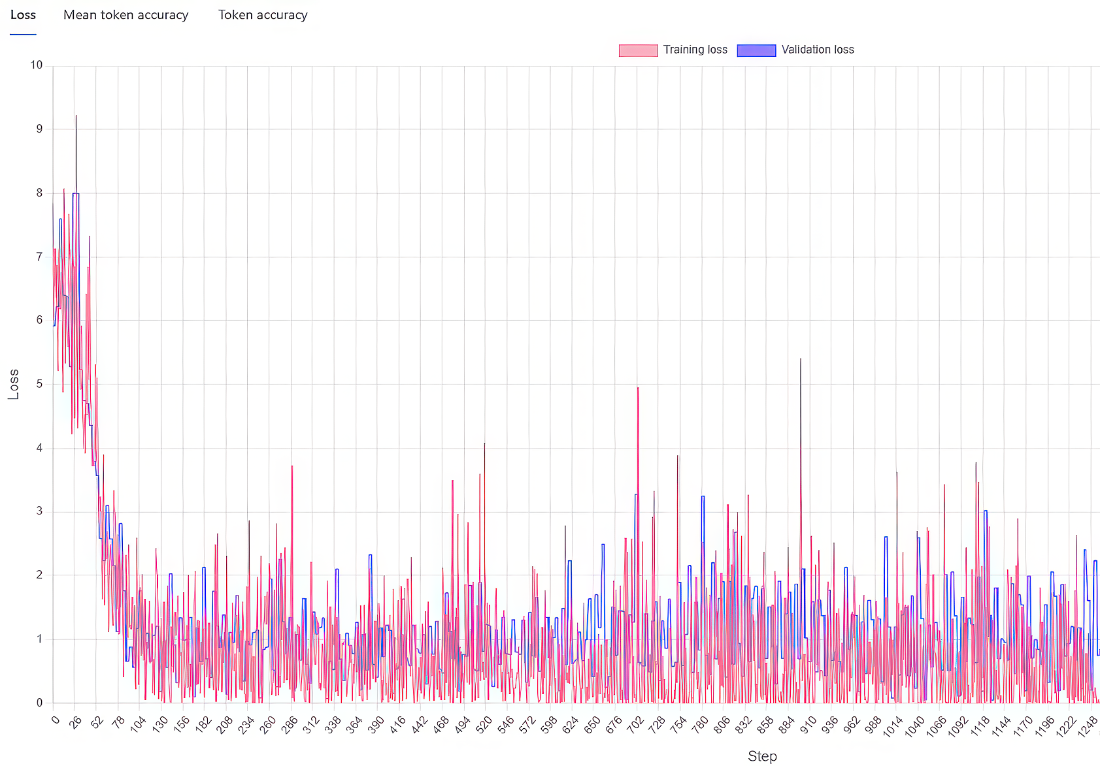
Inspect the training-loss figure to connect epoch-based evaluation with changes in model performance during fine-tuning. section 9.3.4









