An event is a lightweight, immutable record that indicates something occurred. It can identify where the occurrence happened and optionally record whether it passed or failed. Keeping events simple allows platform components to evolve independently while consumers react to a shared stream. section 9.3.1
Use events to connect operational activity with automated platform workflows:
- Represent rollout progress across Kubernetes clusters and regions, including attempts whose success or failure arrives in a later event. section 9.3.1
- Create or update Jira work items when platform changes, such as Kubernetes releases and deprecations, require application-team action. section 9.3.3
- Publish deployment, rollout, and dependency changes into observability systems so teams can correlate failures with upstream releases. section 9.3.5
- Forward release data to a configuration management database to keep service ownership, versions, and application maps current. section 9.3.6
Correlating a deployment with an outage
Team A sees a sudden increase in HTTP errors. Its observability system already contains Team B’s version 1.2 deployment event, making the upstream change visible and accelerating root-cause analysis. section 9.3.5
Figure 9.6 A sample of events that represent the rollout of a new version of Istio to our engineering platform
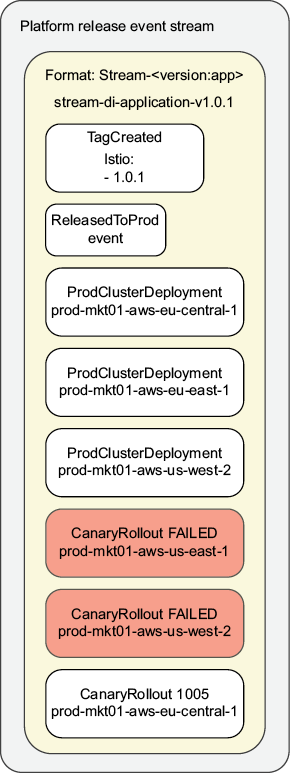
Visualizes events emitted as a new Istio version rolls out across the engineering platform’s Kubernetes clusters. section 9.3.1

















