Facilitation makes the flow of collaborative work easier without taking ownership of the outcome. A facilitator focuses on process, participation, and group dynamics rather than advocating for a preferred decision. This neutrality helps groups discuss conflicts, negative emotions, disagreement, and other sensitive topics openly. section 5.4 section 5.1
Figure 5.1 The facilitator takes on different stances. The observer stance takes a central place, which provides a facilitator with important information to take on other stances.
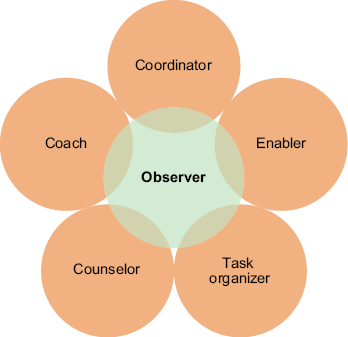
A facilitator can shift among observer, coordinator, coach, enabler, counselor, and task-organizer stances. Observation remains central: it supplies the information needed to choose an appropriate response without directing the group toward a personal answer. section 5.1
Use facilitation to protect participation and make group patterns workable:
- Create a safe space where minority views, disagreement, and uncomfortable emotions can be expressed. section 5.4.1
- Observe communication patterns such as silence, interruption, raised voices, indirect questions, and dominating behavior. section 8.3 section 8.7
- Notice cognitive bias during collaborative modeling, then use relevant heuristics to open new possibilities rather than allowing bias to narrow discussion. section 7.3
- Offer assistance through an explicit agreement with the group or an individual, while maintaining neutral rank and avoiding unsolicited advice. section 8.7
- Write down reactions and observed patterns for later reflection instead of reacting impulsively during the session. section 5.7
BigScreen’s EventStorming session
A group debating whether it was building a standard product or customized solutions faced a topic that felt unsafe to discuss. Facilitation made room for differing perspectives instead of treating resistance as a disruption. In a follow-up Example Mapping session, naming cognitive bias helped the group explore more possibilities and understand the problem more deeply. section 5.4.1 section 7.3
Facilitation does not guarantee the group’s hoped-for result. Its success lies in making collaboration possible; the collective group remains responsible for what it decides. Combining participant and facilitator roles can add distraction and conflicts of interest, so dedicated facilitation is often valuable. section 5.1


