liveBook · Manning

File system

As explained in Bootstrapping Microservices, Second Edition: With Docker, Kubernetes, GitHub Actions, and Terraform

File storage is a persistent storage mechanism that organizes data as files.

Provides persistent storage for files and assets, such as videos served by an application. In a microservices system, file storage can remain behind a dedicated service instead of coupling application logic directly to a provider. section 4.0 section 4.4

A practical file-storage arrangement separates responsibilities:

  • Use external cloud storage such as Azure Storage, AWS S3, or Google Cloud Storage for application files. section 4.4
  • Place a storage microservice between application services and the external provider. section 4.4
  • Use Docker Compose to run the storage service with the rest of a multi-container application during development. section 4.1

Replacing cloud storage locally

A mock-storage service can store videos in a local filesystem instead of Azure Storage. A GET /video request reads a file by identifier, while POST /upload writes the request stream to a path under the service's storage directory. Mounting that directory into the container preserves files during development and avoids external cloud dependencies. section 10.7.2
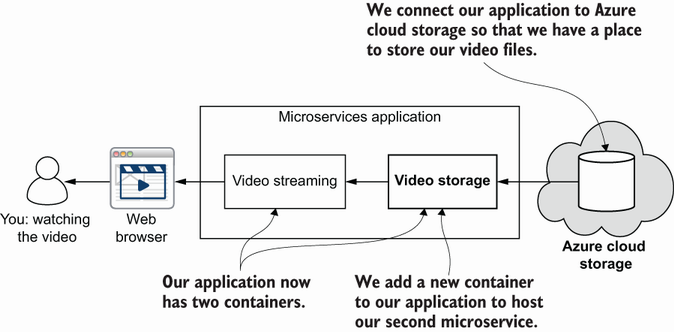
Figure 4.5 We add a second microservice and external cloud storage to our application.

Shows the storage microservice as an intermediary between the video-streaming service and external cloud storage. section 4.4


How Bootstrapping Microservices, Second Edition: With Docker, Kubernetes, GitHub Actions, and Terraform covers it

How deep it goes
Explains provider-backed storage, service abstraction, local replacement, mounted directories, and stream-based file operations.
Examples
Uses Azure Storage, a video-storage service, a mock-storage service, local video files, and Docker Compose volume mounts.
What it assumes
Assumes familiarity with microservices and Docker, then introduces multi-container development and external file-storage integration.
What you can do after
Operate/configure storage through a dedicated service and substitute local filesystem storage for cloud storage during development.
How it connects
Connects file storage with microservices, cloud storage, Docker Compose, separation of concerns, and databases.

Also explained in

Compare how 4 books explain file system →

Related concepts

This explainer was generated by Manning's knowledge graph from the text of Bootstrapping Microservices, Second Edition: With Docker, Kubernetes, GitHub Actions, and Terraform. The section links point to the parts of the book it draws on.

